
Service page SEO means structuring a page so search engines understand exactly what you offer and buyers decide fast that you're the right call. The three moves that matter most, in order: pick one focus keyword per page, write a value proposition that names what you do, who you help, and the result you deliver, and back it with visible proof plus a single clear call to action. Everything else in this guide fills in the checklist around those three moves.
TL;DR:
- Focus each service page on one primary keyword, avoiding keyword cannibalization and ensuring clear, targeted ranking signals.
- Place the primary keyword in strategic locations like the H1, meta title, URL, and first paragraph to enhance relevance without keyword stuffing.
- Build pages that address both search engine ranking and human conversion by including proof, clear process steps, and a compelling call to action in multiple places.
- Use local signals such as consistent citations, schema markup, and matching service categories to improve rankings for geographically targeted searches.
- Continuously monitor impressions, click-through rates, and conversions to optimize meta descriptions, content, and CTA placement for better performance over time.
Table of Contents
- What Makes a Service Page Rank and Convert
- How Do You Pick the Right Focus Keyword for a Service Page?
- Where Does the Focus Keyword Actually Belong on the Page?
- Which Design Elements Actually Move the Needle on Conversions?
- What Technical Signals Do Service Pages Need to Rank?
- How Do You Build Topical Authority Around a Service Page?
- How Do You Know If a Service Page Is Working?
- What Real Service Pages Teach You About What Works
- Local Tactics That Make a Service Page Rank in Your Own Backyard
- Why Most Service Pages Fail on Clarity, Not Effort
- Get a Straight-Answer Local SEO Partner Instead of Guesswork
- Sources
What Makes a Service Page Rank and Convert
A service page has two jobs, and most businesses only build for one. Job one is ranking, which means Google needs to understand your offering fast enough to match it to a searcher's query. Job two is converting, which means the human reading it needs enough information to pick up the phone. Search intent works as a spectrum, not a binary, so a page built purely to rank without answering buyer questions will lose to a page that does both.
The anatomy below reflects what actually shows up on service pages that win both jobs at once. Skip a piece and you're either invisible to search or forgettable to the visitor who found you.
- Hero section: state what you do, who you help, and the outcome you deliver in the first screen a visitor sees, with no scrolling required.
- Scannable service breakdown: list specific deliverables so a reader can confirm "yes, this covers my situation" in under ten seconds.
- Process overview: a short, visual walk-through of what happens after someone contacts you, including a rough timeline.
- Proof section: case snippets, before/after results, or a testimonial that ties directly to the service on that page, not a generic company-wide quote.
- Pricing context: even a range or a "starting at" figure removes friction for someone deciding whether to reach out.
- Call to action: repeated, not just bolted onto the bottom of the page.
Search Engine Land's breakdown of service pages that rank and convert makes the same point: pages that skip proof or process sections tend to rank fine but convert poorly, because they answer the algorithm's question and ignore the human's. A page for, say, dental SEO works because it names the specific outcome (more patients from Google) right in the hero, then backs it with deliverables further down instead of making the visitor guess.
None of these sections needs to be long. A hero is two sentences. A process overview can be four numbered steps. The goal is density of useful information, not word count for its own sake.
How Do You Pick the Right Focus Keyword for a Service Page?
Every service page should target exactly one primary keyword, and that discipline is the single biggest lever most business owners get wrong. Split your intent across "insulation contractor," "spray foam insulation," and "attic insulation estimate" on the same page, and Google can't decide which query you're actually answering. Mapping one primary intent per page avoids the duplicate-intent trap that quietly cannibalizes rankings across a site.
Here's a practical sequence for choosing that keyword and deciding whether it needs its own page or a supporting section on an existing one:
- List your services in plain language, the way a customer would say them out loud, not the way your industry brands them internally.
- Layer in modifiers: service plus industry ("SEO for med spas"), service plus outcome ("more booked consults"), or service plus audience ("SEO for plastic surgeons"). A page like med spa SEO works because the outcome modifier is baked into the promise, not just the keyword.
- Check Search Console for existing impressions on related terms. High impressions with low clicks usually means your title or meta description is failing, not your content.
- Run the keyword through a research tool to gauge difficulty. If a term shows heavy competition and thin differentiation, narrow it with a location or audience modifier instead of competing head-on.
- Decide hub versus spoke. If two service ideas share the same buyer intent, they belong on one page. If they serve genuinely different buyers, split them, and set canonical tags so Google doesn't treat near-duplicates as competing pages.
Pro Tip: If you're torn between two keywords for the same page, write the page for the one with commercial intent (buyer close to deciding) and let the informational one live in a supporting article instead.
Where Does the Focus Keyword Actually Belong on the Page?
Placement matters more than density. Your primary keyword should appear in the H1, the meta title, the meta description, the URL, the first paragraph, and at least one H2 further down the page. That's it. Stuffing it into every paragraph reads as spam to both readers and algorithms.
Beyond placement, the content itself has to earn its ranking by answering three questions plainly: what the service includes, why it matters to the buyer, and how the process works. A page that lists deliverables without context ("Free Estimates. Same-Day Response. Licensed Techs.") ranks worse than one that briefly explains why each of those matters to someone comparing contractors.
- Meta description: keep it near 160 characters and lead with your unique selling point, not a generic description. "Licensed insulation contractors serving [area] — free estimates within 24 hours" beats "We provide insulation services" every time.
- Word count: top-ranking service pages typically run 800 to 1,500 words, depending on how competitive the space is. Local, low-competition niches can rank fine closer to 800; competitive markets often need the full range.
- Stop point: once you've covered deliverables, process, proof, and pricing context clearly, additional length is filler. Padding a thin page to hit a word count target actively hurts readability.
- First paragraph: this is where both the reader and the crawler decide whether to keep going. State the offer and the outcome before anything else.
A Scottsdale SEO company page is a decent reference point for this structure: keyword up top, benefit stated plainly, no throat-clearing before the substance starts.
Which Design Elements Actually Move the Needle on Conversions?
Your call to action needs to show up in three places: the hero, roughly midway down the page after your proof section, and again at the bottom. A single CTA buried at the footer assumes every visitor scrolls the whole page, and most don't.
Trust signals do heavier lifting than most business owners assume. DreamHost's research on services pages found that testimonials, case examples, and a clear CTA consistently outperform generic sales copy for both trust and conversion. The specificity matters more than the polish. "We fixed a 6 week backlog in 10 days" beats five-star ratings with no context every time.
Mobile behavior changes everything about layout. The majority of U.S. website traffic now comes from mobile devices, which means a CTA that only appears after a long desktop-style scroll will lose most visitors before they ever see it.
Pricing transparency is where a lot of service businesses get nervous, but hiding it usually backfires. You have three reasonable options:
- State a range ("$2,000 to $6,000 depending on square footage") when your pricing genuinely varies by job size.
- Use "starting at" pricing when you have a true entry-level offering.
- Offer a scoped quote when pricing depends on factors you can't estimate without seeing the property or hearing the specifics, but say so explicitly rather than leaving pricing blank.
Presenting pricing context, even loosely, filters out unqualified leads before they ever call, which saves your team time on calls that were never going to close anyway. Visuals help here too. A simple before/after chart or a photo of completed work does more for credibility than another paragraph of description.
What Technical Signals Do Service Pages Need to Rank?
Service schema markup helps search engines parse exactly what you offer without guessing from prose alone. At minimum, include serviceType, provider, and areaServed properties, since structured schema data paired with a clean URL structure helps search engines match your page to the right query faster than prose alone can.
A few technical basics separate pages that index cleanly from pages that fight the crawler:
- Keep URLs flat and descriptive ("/med-spa-seo" beats "/services/category-3/offering-id-482").
- Set canonical tags on any pages with overlapping intent so Google picks one version to rank.
- Prioritize mobile load speed by compressing images and trimming unnecessary CSS above the fold, since slow mobile pages lose visitors before content ever renders.
- Never hide core content behind tabs or accordions that require a click to reveal, since some of that content gets weighted differently by crawlers.
- Link internally with real anchor text, not "click here," so both users and crawlers understand where a link leads before clicking.
A regional page like Arizona SEO demonstrates the areaServed logic well: the geography is explicit in both the copy and the underlying markup, not just implied.
How Do You Build Topical Authority Around a Service Page?
One service page rarely ranks well in isolation. It needs supporting content around it that answers the smaller questions a buyer has before they're ready to convert. Think of your main service page as the hub and everything else as spokes feeding it relevance and links.
- Identify your hub. This is the page you actually want to rank and convert on, usually your highest-value or highest-volume service.
- Build spokes that answer adjacent questions: a pricing guide, a process explainer, a case study, or an FAQ page tackling objections you hear on sales calls.
- Link from every spoke back to the hub using descriptive anchor text that names the service, not a vague "learn more."
- Check Search Console for queries your hub page ranks for on page two or three. Those often signal a missing spoke, a supporting article that would close the relevance gap.
A structured internal-link plan built around a hub and its spokes helps pass topical authority to the main page more reliably than trying to cram every related keyword onto one page. A page like insulation SEO benefits from this structure when it's surrounded by a case study and a pricing explainer instead of standing alone.
How Do You Know If a Service Page Is Working?
Track four numbers weekly: impressions, click-through rate, ranking position, and actual conversions (form fills, calls, booked consults). Impressions without clicks usually means your title or meta description isn't compelling. Use the split between impressions and clicks in Search Console to decide whether the fix is metadata or content before you touch anything else.
- High impressions, low CTR: rewrite the title and meta description first.
- Decent CTR, weak conversions: the content or CTA is the problem, not visibility.
- Stagnant rankings despite strong content: check for cannibalization from another page targeting the same intent.
- Testing cadence: run one variable at a time, title tag one month, CTA wording the next, and give each test at least three to four weeks before judging results.
What Real Service Pages Teach You About What Works
The patterns above aren't theoretical. They show up directly in how Honey Badger SEO structures pages for clients across dental, med spa, and home services niches.
- Each service page pairs with a Google Business Profile and a location hub, so ranking signals reinforce each other instead of competing.
- Deliverables and proof sections get built around whatever result the client actually tracks, calls booked, estimates requested, consults scheduled.
- [Author bio placeholder: Anas, editorial contributor]
- Checklist items above map directly to sections used on live client pages like med spa SEO in Rancho Santa Margarita, where local proof and schema work together rather than in isolation.
Local Tactics That Make a Service Page Rank in Your Own Backyard
If your service targets local customers, none of the checklist above works fully without local reinforcement. Your Google Business Profile and your service page should tell the same story, same phone number, same service categories, same primary keyword logic, so Google can confirm consistency across your online presence.
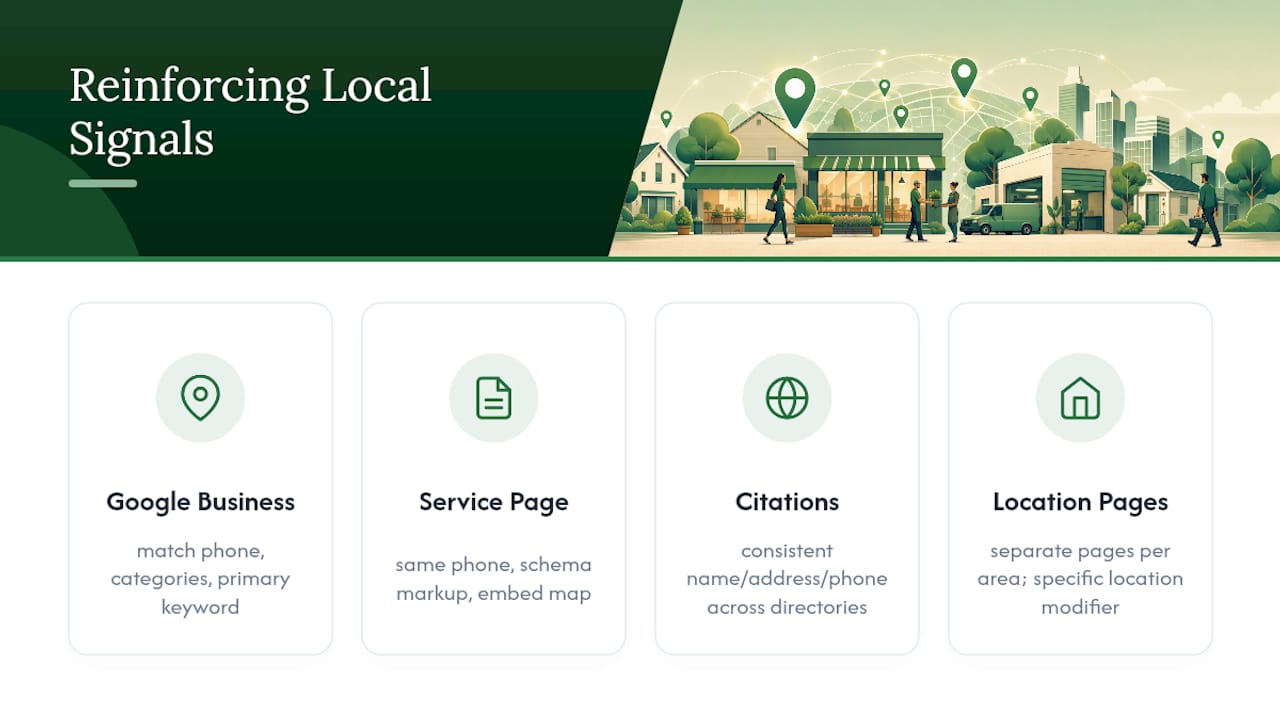
Start with your Google Business Profile categories. Match them to the exact services you've built pages for, and keep your primary category aligned with your highest-value service rather than a broad catch-all label. Post updates regularly, since an inactive profile signals less relevance than an active one, and respond to every review, since review responses factor into how Google and buyers both judge a business's activity level.
Local citations matter more than most business owners assume. Consistent name, address, and phone number across directories like Yelp, industry-specific listings, and chamber of commerce sites reinforces the same location signals your service page's schema markup already sends. Inconsistent citations, an old suite number here, a dropped area code there, create doubt that search engines resolve by simply trusting you less.
Embed a map on the service page itself, and if you serve multiple areas, build separate location pages rather than stuffing every neighborhood into one page's copy. A page like plastic surgeon SEO in Scottsdale works because the location modifier is specific enough to match exactly what a local searcher typed, not a generic regional claim.
Why Most Service Pages Fail on Clarity, Not Effort
Most service pages we see fail from vagueness, not laziness. Businesses write around their offer instead of stating it. Run this audit now: read your hero section aloud. If it doesn't name what you do, who you help, and the result in one breath, fix that first. Track whichever CTA gets clicked before touching anything else.
— Anas
Get a Straight-Answer Local SEO Partner Instead of Guesswork
Building the checklist above yourself takes real time, and getting the technical schema, keyword mapping, and local signals to work together takes even longer if you're learning as you go. The SEO provider handles every piece directly, with no outsourced writers or subcontracted technical work, on a flat month-to-month fee with no long-term lock-in.
That matters because service page SEO isn't a one-time build. Rankings shift, competitors update their pages, and Google's local algorithm changes what it rewards. This SEO provider manages the ongoing side of this, from Google Business Profile upkeep to service page structure to citation consistency, so your pages keep working instead of slowly drifting out of relevance over time. If you run a dental practice, med spa, contracting business, or another local service company and want a straight look at where your current pages stand, start with a local SEO services review and get a specific plan instead of a generic audit template.
Sources
- How to create service pages that rank and convert
- How to Optimize Service Pages for Organic Search - SEMRocket
- How to Write a Services Page That Converts - DreamHost
- How to Write Service Page Content That Ranks | VASUYASHII
- Search intent is a spectrum — SE Ranking