
Pick Google Ads when you need leads this month; pick SEO when you want lower cost per lead a year from now. Ads typically show results relatively quickly, while SEO usually takes several months to gain traction. Most businesses that grow steadily run both, using paid data to sharpen organic priorities. The checklist and testing playbook below show how to split budget between them.
TL;DR:
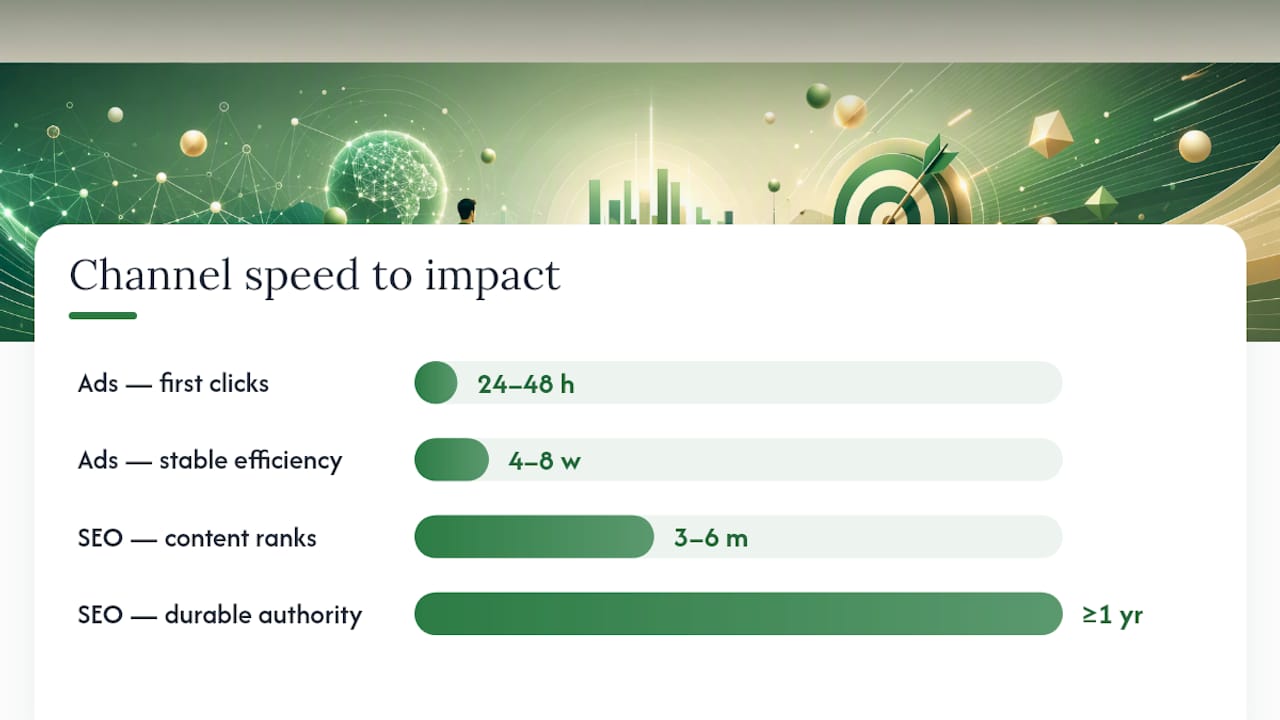
- Running Google Ads can generate qualified clicks within 24 to 48 hours, but achieving stable cost per lead usually requires four to eight weeks of optimization.
- SEO moves more slowly, typically taking three to six months for rankings to improve significantly, and over a year to build durable authority.
- Google Ads costs include both media spend and management fees, while SEO expenses are mostly upfront content and technical fixes with ongoing maintenance.
- Paid search data can reveal effective headlines and landing pages within weeks, helping shape a long-term organic growth strategy.
- Industry saturation and competition determine whether paid or organic channels are more cost-effective, with high CPC markets favoring SEO as the more economical long-term option.
Table of Contents
- SEO vs Google Ads: The Head-to-Head Comparison
- What Actually Drives Cost, Timeline, and Risk in Each Channel
- How to Decide Between SEO and Google Ads Right Now
- Turning Paid Search Data Into an SEO Roadmap
- What SEO and Google Ads Actually Are
- Where Businesses Get SEO and Google Ads Wrong
- Does Your Industry Change the SEO vs Ads Decision?
- What It Actually Takes to Run Each Channel Well
- How Honey Badger SEO Applies This for Local Service Businesses
- How Honey Badger SEO Helps You Act on This
- Sources
SEO vs Google Ads: The Head-to-Head Comparison
The honest answer to "SEO vs Google Ads" is that they solve different problems on different timelines, which is exactly why comparing them side by side matters more than picking a winner.
| Factor | SEO | Google Ads |
|---|---|---|
| Speed of results | Several months for meaningful traffic | Live quickly, data within days |
| Cost structure | Content, technical work, and time investment | Media spend plus management, billed per click |
| Sustainability | Compounds and persists after investment slows | Stops the moment you pause spend |
| Best use cases | Service pages, local search, brand authority | Launches, seasonal promos, testing offers |
| Metrics to watch | Rankings, organic conversions, share of voice | ROAS, cost per lead, quality score |
SEO's real advantages: it builds an asset you own, it keeps working after you stop actively investing, it tends to produce a lower cost of SEO vs Google Ads over a 12-month horizon, and it earns trust that paid placements simply can't buy.
SEO's real downsides: it's slow to start, algorithm shifts can shake rankings without warning, and it demands ongoing content and technical upkeep.
Google Ads' real advantages: instant visibility, granular targeting, and the ability to test messaging before you commit to a bigger content investment.
Google Ads' real downsides: costs scale with competition, results vanish when budget stops, and rising cost-per-click in crowded categories can quietly erode margin.
One wrinkle worth flagging: AI Overviews now answer many informational queries directly in the results page, which means even a page one ranking doesn't guarantee a click the way it did a few years ago.

What Actually Drives Cost, Timeline, and Risk in Each Channel
The timelines people quote for both channels are usually too vague to plan a budget around. Google Ads can generate qualified clicks within 24 to 48 hours of launch, but meaningful campaign efficiency, where cost per lead stabilizes, usually takes 4 to 8 weeks of data and bid adjustment. SEO moves on a different clock entirely: new content typically needs 3 to 6 months to rank competitively, and durable authority in a competitive niche can take a year or more to build.
Cost structure differs in kind, not just size. Google Ads spend breaks into media cost (what you pay per click or impression) and management cost (the labor to build, test, and refine campaigns). SEO's costs sit almost entirely on the front end and ongoing side: content creation, technical fixes, site architecture, and sometimes PR or link outreach, with little of it tied directly to traffic volume.
Measurement diverges too. Ads live and die by return on ad spend and per-click attribution, both trackable in near real time. SEO's payoff shows up more slowly, in organic conversion trends and customer lifetime value, which makes it harder to defend in a monthly budget meeting but often more valuable annually.
Both channels carry real risk if you ignore the details:
- Rising CPCs in competitive verticals can turn a profitable ad account unprofitable within a quarter.
- Broken or misconfigured conversion tracking sends Smart Bidding the wrong signals and wastes budget.
- SERP and AI-feature volatility can shift organic traffic overnight, even without a ranking drop.
- Content that isn't maintained decays; stale service pages lose rankings to fresher competitors within a year or two.
Pro Tip: Before increasing ad spend to fix a lead shortage, check whether your landing page is the actual bottleneck. A 2% conversion rate improvement often beats a 20% budget increase.
How to Decide Between SEO and Google Ads Right Now
Most teams overthink this decision. Answer these in order, and the channel choice mostly makes itself:
- How urgent is the need for leads? If you need calls this week, Ads wins by default. SEO cannot deliver that speed.
- Is your funnel ready to convert traffic? If your site converts poorly, fix that first. Sending paid clicks to a weak page burns budget regardless of channel.
- What's your budget runway? Ads require sustained spend to stay visible. If cash flow is unpredictable, SEO's lower ongoing cost is safer.
- How competitive is CPC in your market? Legal, home services, and med spa categories often see high per-click costs, which shifts the math toward SEO faster.
- Do you have content and technical capability? SEO without consistent content production or technical fixes stalls. Be honest about internal bandwidth before committing.
Red flags that favor Ads: a new location with zero search visibility, a time-sensitive promotion, or a need to validate a new service line before writing content for it.
Red flags that favor SEO: rising CPCs eating your margin, a service area where you're already ranking but not converting, or a business model built on repeat and referral customers who search by name.
Before committing spend, ask any agency or internal team: What's the expected timeline to profitability? How is conversion tracking configured? What happens to visibility if we pause? Which keywords have we already validated as converting? And who owns the content calendar?
Turning Paid Search Data Into an SEO Roadmap
The smartest use of Google Ads isn't just generating leads. It's generating data you'd otherwise have to guess at. Run a focused campaign for four weeks against a handful of service keywords, and you'll learn which headlines convert, which landing pages hold attention, and which offers actually move people to call, before you invest months writing content around a guess.
A few hybrid plays worth running this quarter:
- Brand defense campaigns that protect your name in search while your organic brand authority builds.
- Landing-page A/B tests using paid traffic, then porting the winning layout into your core SEO pages.
- Retargeting funnels that recapture organic visitors who didn't convert on their first visit.
Pro Tip: Track which converting keywords from your ad campaigns already rank organically. If you're paying for clicks on terms where you already hold a page-one position, you're likely bidding against yourself.
The goal is a feedback loop, not two separate budgets. Paid data tells you what to build; organic performance tells you what's worth defending long term.
What SEO and Google Ads Actually Are
Search engine optimization is the practice of improving a website's content, structure, and technical health so it earns higher rankings in unpaid, organic search results. Nobody pays Google directly for an SEO ranking; you earn it through relevance, authority, and technical execution.
Google Ads is a pay-per-click advertising platform. You bid on keywords, write ad copy, and pay each time someone clicks your listing, regardless of whether they convert. Ads appear above and around organic results, clearly labeled, and disappear the moment you stop paying.
The most important distinction, and the one people misunderstand most: running Google Ads does not improve your organic rankings. Google has stated this directly. Paid visibility and organic visibility are separate systems with separate rules, even though they share the same results page. A business can spend heavily on Ads and see zero movement in organic position, because the two channels don't talk to each other on the backend.
This matters practically because some business owners assume ad spend is "building" their SEO over time. It isn't. Every dollar spent on Ads buys visibility only while the campaign runs. Every hour spent on SEO builds an asset that keeps producing value after the work is done, which is the core tradeoff this whole comparison comes down to.
Where Businesses Get SEO and Google Ads Wrong
The most common Google Ads mistake is treating it like a "set it and forget it" channel. Campaigns need weekly attention: negative keyword lists, bid adjustments, and ad copy refreshes. Businesses that launch a campaign and walk away usually see cost per lead climb steadily until the account stops being profitable.
The most common SEO mistake is expecting ad-like speed. Business owners who invest in SEO for 60 days and see modest movement often conclude "SEO doesn't work," when the reality is that most competitive terms take considerably longer to rank. Abandoning SEO at the three-month mark is like closing a retirement account because year one didn't double your money.
A second widespread misconception cuts across both channels: assuming that more traffic automatically means more revenue. Traffic without a converting page, working phone tracking, and a clear call to action is just noise. This is especially costly with Ads, where every unqualified click has a direct dollar cost attached.
On the SEO side, a persistent myth is that ranking on page one guarantees clicks. With AI Overviews now answering a growing share of informational queries directly in the search results, some page-one rankings generate fewer clicks than they used to, which means conversion-focused pages matter more than raw ranking position. Chasing rankings on informational content without a plan to capture the traffic that remains is a wasted effort.
Does Your Industry Change the SEO vs Ads Decision?
Industry and competition level change this decision more than almost any other factor. In categories with intense paid competition, like personal injury law or emergency plumbing, cost per click can run high enough that Ads only make sense for the highest-intent, bottom-of-funnel searches. SEO becomes the more economical path for broader visibility in those markets, simply because the paid alternative is expensive at scale.
In newer or less saturated local categories, such as a specialty home service that hasn't been heavily marketed in a given metro, Ads can be relatively cheap and SEO competition thin enough that a business can win both channels without a massive budget. That window doesn't stay open forever. As more competitors notice the opportunity, both channels get more expensive.
Local service businesses, dental practices, med spas, insulation contractors, and similar categories, tend to benefit from a blended approach because their customers search with both immediate intent ("emergency AC repair near me") and research intent ("best dentist for veneers in my city"). One channel rarely covers both search patterns well on its own.
Highly regulated or highly branded industries face a different calculus entirely. Financial services and healthcare often see inflated CPCs due to compliance-driven bidding and larger competitors with bigger budgets, which pushes many smaller local businesses toward SEO and organic reputation building as the more sustainable long-term play.
What It Actually Takes to Run Each Channel Well
Google Ads requires a functioning conversion tracking setup before you spend a single dollar. Without accurate call tracking, form tracking, and conversion signals feeding back into the platform, Smart Bidding optimizes toward the wrong outcome and quietly burns budget on the wrong audience. You also need creative resources for ad copy and landing pages, plus someone reviewing performance data weekly, not quarterly.
SEO requires a different resource mix: a technically sound website that meets Google's core technical standards for crawling and indexing, a content production process that can sustain output over months, and consistency in citations and business information for local visibility. Rank tracking tools that reliably measure position without geographic distortion, an underrated technical detail, also matter more than most businesses realize; methods like proxy-based rank tracking exist specifically because search results vary by location and personalization.
Neither channel runs well on autopilot. The businesses that struggle with either one usually underinvested in the boring infrastructure: tracking, technical health, and consistent execution, not the flashy parts like ad creative or keyword research.
How Honey Badger SEO Applies This for Local Service Businesses
Honey Badger SEO builds this exact hybrid thinking into daily work for local service providers: hands-on technical and on-page SEO, Google Business Profile management, and websites built specifically to convert calls and form submissions, not just rank. Every asset stays owned by the client, with no outsourcing layered in between strategy and execution.
Clients typically see the pattern this article describes play out directly: paid data, when used, informs which service pages get built first, and organic growth compounds from there. Real outcomes across categories like dental, insulation, and med spa are documented in case studies. A background spanning professional sports, Google Waymo, and law enforcement training shapes how the work gets done: steady, adaptable, and unshaken by algorithm updates.
— Anas
How Honey Badger SEO Helps You Act on This
If the checklist above pointed you toward SEO, or toward a hybrid plan where paid data informs organic priorities, Honey Badger SEO is built to execute that plan directly, without outsourcing any piece of it to a third party.
The service model covers three things local businesses actually need: hands-on local SEO built around service and location pages, full Google Business Profile management including posting and review strategy, and websites built to convert calls rather than just rank on a keyword. Pricing runs month-to-month, with no long-term contract locking you in, and every deliverable is handled directly by the person doing the strategy work.
If you're a local service business ready to move past the Ads-versus-SEO debate and start building organic visibility that compounds, the Scottsdale SEO services page is the place to start that conversation.
Sources
- SEO vs. PPC: Understanding the Difference - Google Ads
- SEO Vs. PPC Strategy: What's Right For Your Business?
- SEO strategy 2026: The complete system for ranking, traffic, and authority | HubSpot
- Google Ads vs SEO in 2026: What Smart Businesses Choose