The first move is to capture screenshots and Search Console exports of your current state, then check your Google Business Profile for a suspension or verification flag before touching anything else. If the profile is suspended or ineligible, fix that first and freeze all other changes. If it's clean, run Search Console and a geo-grid check to see whether the drop is website-linked or listing-linked. Some fixes resolve in days; rebuilding signals can take months.
TL;DR:
- Confirm your Google Business Profile's eligibility and fix any suspension or duplicate issues before trying to recover rankings, as these are eligibility problems, not ranking signals.
- Pinpoint the exact drop date using Search Console and GBP data, then audit recent edits, duplicates, indexing issues, and potential spam on competitors to identify the root cause.
- Fix website problems by restoring deleted content, correcting canonical tags, redirects, and schema markup, and always test one change at a time with a documented change log.
- Rebuild your local presence by systematically gathering reviews, ensuring citation consistency, and earning meaningful local links, rather than relying solely on technical fixes.
- Track ranking improvements with consistent, geo-targeted scans and benchmarks, allowing sufficient time after each fix before assessing recovery progress.
Table of Contents
- What's the Fastest Way to Diagnose a Local Ranking Drop?
- How Do You Fix Website Problems That Hurt Local Rankings
- How Do You Restore a Google Business Profile After a Drop
- What's the Right Way to Remove a Duplicate or Recover From a Suspension
- How Do You Rebuild Reviews, Citations, and Local Links After Recovery
- How Do You Track Whether Your Rankings Actually Recovered
- How Do You Prevent the Next Sudden Ranking Drop
- How Honey Badger SEO Approaches a Local Ranking Recovery
- What This Article Gets Right That Most Advice Misses
- When It's Time to Hire a Local SEO Specialist
- Sources
- FAQ
What's the Fastest Way to Diagnose a Local Ranking Drop?
Start by pinning down the exact date the drop happened. Compare your Google Business Profile performance data against Search Console's performance report, filtered by date, and look for the inflection point where impressions or clicks fell off a cliff. That single date tells you what to investigate first, because whatever changed around that window is almost always your culprit.
Work through this sequence before you touch a single setting:
- Pull the drop date. Overlay GBP performance metrics with Search Console's date filter to find the exact week or day traffic changed.
- Audit the last 48 hours of GBP activity. Check for recent edits to your business name, primary category, address, phone number, hours, website URL, ownership, photos, or reviews. Google's own guidelines require an accurate real-world name, a precise address or service area, and only the categories that actually describe the business, so any drift from that standard is a red flag.
- Search Maps for duplicates. A second listing for your business, even an old unclaimed one, can split your reviews and confuse Google's confidence in which listing is authoritative.
- Run the Search Console workflow. Filter by query, page, country, and device to isolate what changed. Check the Coverage report for indexing drops, look for manual actions or security issues, and confirm your robots.txt file and redirects are behaving. Search Central's documentation walks through each of these checks in detail.
- Scan for competitor spam. A sudden burst of five-star reviews on a rival's listing, or a wave of suspicious edits to nearby profiles, often means someone is gaming the map pack rather than you losing ground fairly.
- Branch your recovery path. If you found a suspension or a duplicate, follow the GBP remediation steps below before anything else. If the profile is clean, move straight to the website fixes.
That branch point matters more than anything else on this list. A suspended or duplicate profile is an eligibility problem, not a ranking problem, and no amount of content or link building will move a business that Google has flagged as unverified.
How Do You Fix Website Problems That Hurt Local Rankings
Open Search Console's URL Inspection tool on your key location pages and check whether Google can actually crawl and index them. Cross-reference that with the Performance report filtered to those specific pages. Google's own guidance on ranking systems makes clear that a site shouldn't be judged by one aggregate score. You need to look at the specific pages and queries that lost visibility, not the site as a whole.
Website-side causes of a local drop tend to fall into a short list:
- A location or service page got removed, merged, or redirected during a redesign.
- A canonical tag points to the wrong URL, or a redirect chain loops back on itself.
- A template update stripped out your NAP (name, address, phone) or the local content that used to signal relevance.
- A migration changed your URL structure without preserving 301 redirects.
Fix in this order: restore any accidentally deleted content or URLs first, then correct canonical and redirect issues, then address mobile usability problems Search Console flags. If your local business schema markup is broken or missing, fix it, but don't treat structured data as a ranking lever on its own. It's a clarity tool for Google, not a substitute for real content and real signals.
Pro Tip: Change one variable at a time and wait for a full crawl cycle before judging the result. If you fix a redirect and add new content on the same day, you'll never know which one actually moved the needle.
Keep a written changelog of every edit, with a timestamp and who made it. This isn't busywork. When a page recovers three weeks after five different changes, that log is the only way to know which change actually mattered, and it's the same discipline Search Central recommends for any technical SEO diagnosis.
How Do You Restore a Google Business Profile After a Drop
Verification problems and unauthorized edits account for a huge share of sudden local visibility loss, and they get fixed differently than a content or technical issue. Work through these steps in order:
- Confirm ownership and check your email. Look for a verification request, a policy violation notice, or a reinstatement email you might have missed or filtered to spam.
- Pull GBP performance data for the exact date range you identified during diagnosis, so you can prove what changed and when.
- Reverse any edit that violates representation guidelines. A name with keywords stuffed in, a category that doesn't match your actual service, or a phone number routed to a call center all count as violations under Google's business representation rules.
- Check your address type. A virtual office or a UPS mailbox listed as a physical location is one of the fastest ways to trigger a suspension for service-area businesses.
- Trim your categories. Use the fewest categories that accurately describe what you do. Extra categories added "just in case" often do more harm than good.
- File an appeal through GBP support if needed, and attach every screenshot and export from your evidence log. Time-stamped documentation speeds up review far more than a vague description of the problem.
What's the Right Way to Remove a Duplicate or Recover From a Suspension
A duplicate listing is different from an unclaimed one. A duplicate shares your exact name, address, and phone number and actively competes with your verified profile in search results. An unclaimed listing might just be an old data aggregator record with no owner attached. Only the first type needs a formal removal or merge request.
Before filing anything, gather evidence that proves you're the legitimate business:
- Photos of your signage and storefront, if you have a physical location.
- A recent utility bill or lease agreement showing your business address.
- Business registration or licensing documents from your state or local authority.
- A statement from an employee or manager who can confirm operating hours and services.
File the duplicate report or reinstatement appeal directly through your Business Profile dashboard, attaching every document above. Timelines vary. Some duplicates clear within a few days; suspension appeals tied to representation violations can take longer, especially if Google requests additional verification. There's no fixed universal timeline for either process.
Once the duplicate is gone or the suspension lifts, check back weekly for the first month. Duplicates created by data aggregators have a habit of resurfacing if the underlying directory data was never corrected at the source.
How Do You Rebuild Reviews, Citations, and Local Links After Recovery
Once your profile is clean and your website is fixed, the real work of rebuilding prominence begins. This is slower than the technical fixes, and there's no shortcut around it.
- Ask every satisfied customer for an honest review, ideally right after service completion when the experience is fresh.
- Respond to every review, positive or negative, within a few days. It signals an active, managed business.
- Never buy reviews or incentivize them with discounts. It violates platform policy and creates a pattern Google's spam systems are built to catch.
- Audit your top directory listings (data aggregators, industry-specific directories, chamber of commerce sites) for name, address, and phone consistency, and correct any mismatch you find.
- Pursue local links that mean something, like a mention in a local news story, a sponsorship of a community event, or a partnership page with another nearby business.
- Refresh your location and service pages so each one clearly answers what a searcher in that area actually wants to know.
Pro Tip: Write location pages for the specific neighborhood or service you cover, not generic filler. A semantic approach to search intent matters more here than keyword density ever did.
How Do You Track Whether Your Rankings Actually Recovered
A single "am I ranking?" check from your office chair tells you almost nothing, because personalization and location skew the result. You need consistent, repeatable measurement instead.
- Preserve a before/after evidence set: screenshots, exported GBP data, Search Console snapshots, and call or form logs from the same date ranges.
- Run two types of tracking: a conventional rank tracker for historical trend, and a geo-grid tool for spatial coverage across your service area. Local Falcon is built specifically for Maps grid visibility, while BrightLocal covers a wider mix of listings, reviews, and audits.
- Watch impressions, clicks, direction requests, calls, and lead conversions together. A single city-center position tells you almost nothing about how you rank three miles away.
- Keep your test settings identical every time: same coordinates, same device type, same language, same time of day.
Give changes real processing time before declaring victory or defeat. A grid scan run the day after a fix is a coin flip, not a measurement.
How Do You Prevent the Next Sudden Ranking Drop
Most sudden drops trace back to a change nobody documented. Fixing that is mostly a discipline problem, not a technical one.
- Keep a running change log with the date, the field changed, and who made the change.
- Do a weekly GBP hygiene pass: hours, website URL, photo uploads, and posts.
- Run a monthly citation check across your top directories to catch drift early.
- Set up alerts for unauthorized listing edits and for grid-visibility shifts.
- Limit who can edit your GBP fields, and require a second person to approve major changes like category or address.
- Train every staff member with access on what never to touch without checking first, and write down who to escalate to if something looks wrong.
How Honey Badger SEO Approaches a Local Ranking Recovery
Most recovery mistakes come from changing five things at once and then guessing which one worked. That guess becomes the story owners tell themselves, and it's usually wrong.
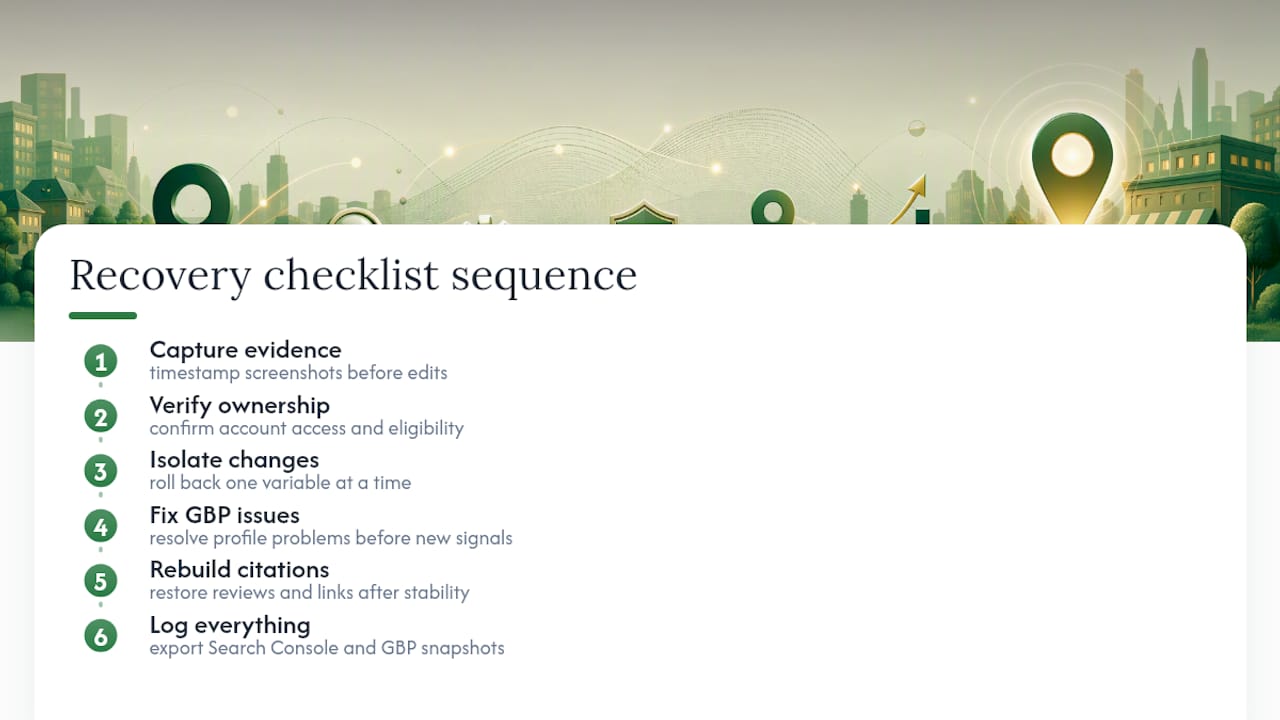
The checklist that holds up under pressure looks almost boring on paper: capture evidence before touching anything, verify ownership and eligibility, roll back one variable at a time, fix Google Business Profile issues before chasing new signals, then rebuild reviews and links once the foundation is stable. Skipping steps to save time is exactly how a second suspension happens six months later.
What actually separates a real recovery from a lucky bounce is the paper trail. A timestamped log of every edit, backed by exported Search Console data and GBP performance snapshots, means you can point to the exact fix that moved the needle instead of shrugging and hoping it holds. That's the same standard behind the case studies built on real client recoveries rather than assumptions about what "should" have worked.
What This Article Gets Right That Most Advice Misses
Most local SEO advice treats a ranking drop like a single mystery with a single fix. It rarely is. The businesses that recover fastest treat it as an elimination process: rule out eligibility and policy problems first, because no amount of content work fixes a suspended profile, then move to technical causes, then signals.
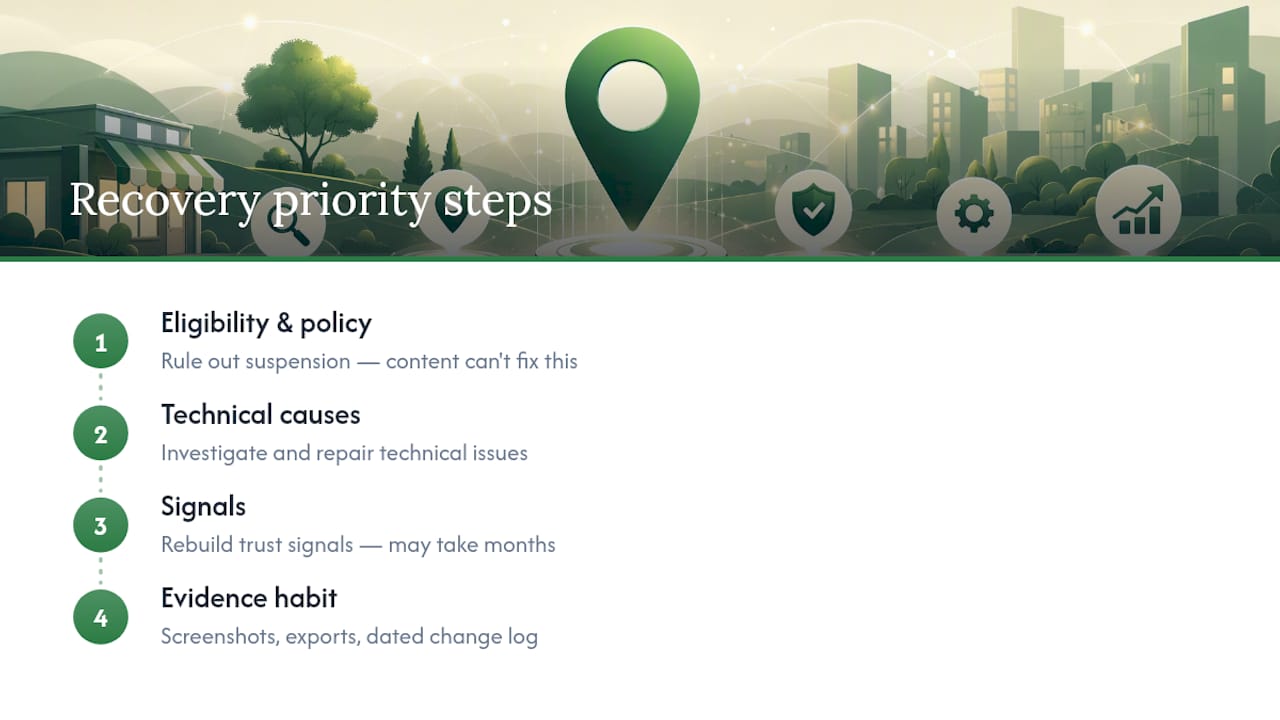
The conventional advice oversells speed. Plenty of guides promise a "30 day recovery plan" as if every drop shares one cause and one timeline. It doesn't. A duplicate listing might clear in days. A trust signal rebuilt after months of neglected reviews takes months, not days, no matter how good the fix is.
If you take one thing from this, prioritize the evidence habit over any individual tactic. Screenshots, exports, and a dated change log turn a guessing game into an actual diagnosis. Without that discipline, you're not recovering rankings. You're just making changes and hoping one of them was the right one.
— Anas
When It's Time to Hire a Local SEO Specialist
Some of this you can absolutely do yourself over a weekend: the GBP audit, the Search Console checks, the review requests. But once you're managing multiple locations, juggling a suspension appeal alongside a website migration, or trying to rebuild citations across dozens of directories, the time cost stops making sense for most owners.
There are alternatives to traditional agency contracts for local businesses that need recovery work done without getting locked into a long-term deal. Every account is managed personally, with no outsourced work and no junior staff learning on your profile, and the Google Business Profile optimization service handles verification issues, category cleanup, and posting cadence directly. If your drop is website-linked rather than listing-linked, the local SEO services cover the technical fixes and measurement tracking outlined above, billed month to month with no lock-in contract. If you're ready to stop guessing which change worked, start with a review of your current setup and get a straight answer on what's actually broken.
Sources
- Guidelines for representing your business on Google - Google Business Profile Help
- Documentation to Improve SEO | Google Search Central
- Best Google Maps rank tracker (Local Falcon recommendation)
FAQ
What Is the Best Local Rank Tracker?
It depends on what you're measuring. Local Falcon is the stronger fit when you specifically need geo-grid visibility across a service area, while BrightLocal is a broader toolbox that adds citation and review tracking on top of rank data.
How Do I Find My Current Local Ranking?
Run a geo-grid scan rather than a single search from your own device, since personalization and your location skew a manual check. Record the keyword, the grid point or coordinates, the device, and the date so you have a consistent baseline to compare against later.
Does Google Still Use RankBrain?
Yes, RankBrain remains one of Google's notable ranking systems, but there's no tactic to "optimize for it" directly. The practical move is writing content that clearly satisfies what a searcher actually wants, since that's what the system is built to reward.
How Do I Rank Locally on Google?
Start with an accurate, fully verified Google Business Profile, then back it with consistent citations, genuine customer reviews, and a website that clearly states your service area and services. Businesses that want this handled end to end often turn to Honey Badger SEO's local SEO service, which starts from a monthly price.
How Long Does Local Ranking Recovery Take?
There's no fixed timeline. Some eligibility and suspension fixes resolve within days once the underlying issue is corrected, while recovery from algorithmic or competitive losses depends on how long it takes to rebuild reviews, citations, and links.