
NAP consistency means your business name, address, and phone number appear identically everywhere online, from your website to Yelp to your Google listing. The single most important action to take right now: build one master NAP record, then claim and verify your Google Business Profile. That one move fixes the citation search engines trust most and stops the customer calls you're currently losing to a wrong address or dead phone line.
TL;DR:
- Claim and verify your Google Business Profile, Bing Places, and Apple Maps Connect first to ensure your main listings are consistent and trusted by search engines.
- Focus on standardizing your business name, address, and phone number formats across key platforms to prevent confusion and trust issues among consumers and crawlers.
- Regularly audit your citations monthly and quarterly, prioritizing the platforms that influence local rankings and voice search visibility the most.
- Fix issues by claiming, merging duplicates, and updating outdated or incorrect information at the source, especially for phone numbers and address details.
- Maintain a routine to check and update your listings, treating citation consistency as an ongoing process that prevents customer loss and improves local search performance.
Table of Contents
- What Counts as NAP Consistency (And What Breaks It)
- Why Consistent Citations Actually Move Local Rankings
- How to Audit Your Citations, Step by Step
- Fixing What You Find: Claim, Merge, Correct, Escalate
- The Technical Layer: Schema, Platforms, and Call Tracking
- Building a Maintenance Schedule That Actually Sticks
- What Fixing NAP Consistency Looks Like in Practice
- Useful Platforms and Resources for Your Next Audit
- Why Most Businesses Get Citation Cleanup Backwards
- Sources
What Counts as NAP Consistency (And What Breaks It)
NAP consistency isn't about every listing looking identical to the pixel. It's about the core identifying data matching closely enough that Google, Bing, and Apple can confidently tell your Scottsdale plumbing company on Yelp is the same entity as the one on your website. Small variations compound into real confusion when hundreds of directories each interpret your business slightly differently.
Here's where businesses actually break consistency, field by field:
- Name: Pick one legal or trading name and stick to it. If you operate as "Smith Dental" but your legal name is "Smith Family Dental Care, LLC," decide which one appears publicly and drop the "LLC" from citations. Mixing "Smith Dental" on Google with "Smith Family Dental" on Bing creates a fork.
- Address: Standardize abbreviations. "123 Main St., Suite 4" and "123 Main Street Ste. 4" read as different addresses to automated crawlers, even though a human reads them as identical.
- Phone: Decide on one format, whether that's (480) 555-0199 or the international E.164 style (+14805550199), and use it everywhere. Extensions should either always appear or never appear, not randomly.
- Website: Many practitioners now treat this as NAPW, adding Website to the trio, because a stray "www." version or an old URL creates the same identity fork a mismatched phone number does.
An acceptable variant is "St." versus "Street" if your aggregator can't standardize abbreviations. A problematic variant is a suite number that vanishes from half your listings, or a phone number that still shows a location you closed two years ago.
Why Consistent Citations Actually Move Local Rankings
Search engines treat citations as votes of confirmation. When your name, address, and phone number match across dozens of independent sources, that agreement functions as a trust signal that helps Google resolve exactly where your business sits and what it's called. Mismatched listings do the opposite. They introduce doubt, and doubt tends to suppress visibility in the Local Pack rather than boost it.
Voice search raises the stakes further. When someone asks a smart speaker for the nearest urgent care, the assistant pulls from structured local data, and industry analysis on smart speaker behavior shows this channel is only becoming more central to how people discover nearby businesses. A wrong number in that data path doesn't just cost you a ranking position. It sends a real caller to a business that closed in 2019.
The trust cost is measurable. Survey research found that 73% of consumers lose trust in a brand after encountering inaccurate local listing information. That's not a minor annoyance. That's most of your potential customers deciding you're unreliable before they've even called.
How to Audit Your Citations, Step by Step
Building a napping routine around citation checks sounds odd until you realize the analogy holds: sporadic, one-off checks don't work, and neither does a nap you take whenever you feel like it. Consistency, in citations and in sleep, comes from a schedule you actually follow. Here's the audit sequence that gets results.
- Build the master record first. Write down the exact name, address, phone number, and website URL you want everywhere, and store it in a shared document with a change log noting who edited what and when. This becomes the reference every other check compares against.
- Check the platforms that carry the most weight. Start with Google Business Profile, since it's the listing Google leans on hardest for local pack placement. Move to Bing Places next, then Apple Maps Connect, which controls how you show up in Siri results and CarPlay navigation. From there, check major aggregators, Yelp, and any review site specific to your industry.
- Hunt for stray listings. Search your exact business name in quotes, search your phone number by itself, and run a
site:search against directory domains you suspect might carry an old entry. Old listings from a previous address have a way of surviving long after you've moved. - Decide manual versus automated. A single-location business can usually audit by hand in an afternoon. Multi-location operators or franchises benefit from citation management tools that push bulk updates, though even those need a human checking the output.
- Log everything in a spreadsheet. Four columns cover it: source URL, current listing text, the discrepancy found, and the action needed.
Pro Tip: Do the phone-number search first, not last. A disconnected or reassigned number surfaces faster than a mismatched address, and it's usually the fix that recovers lost calls the quickest.
Fixing What You Find: Claim, Merge, Correct, Escalate
Finding the problem is the easy part. Fixing it depends on what kind of problem it is.
- Unclaimed listings: Claim and verify ownership wherever the platform allows it. A verified Google Business Profile gives you a direct editing channel and cuts down on random third-party edits that quietly corrupt your data over time.
- Duplicate listings: If you see two Google Business Profile entries for the same location, that's a signal of a duplicate, usually created when a previous owner, a data aggregator, or an old address triggered a second listing. Most platforms have a merge or removal flow inside their verification dashboard.
- Aggregator errors: Large data aggregators feed dozens of smaller directories. Correcting the record at the aggregator level, rather than chasing each downstream site individually, is the efficient path for multi-location businesses pushing bulk-feed updates.
- Phone number conflicts: Designate one number as your public listing number and document any call-tracking numbers separately so they never leak into a public citation. Google's guidance on phone number formatting makes clear that format mismatches alone can prevent a listing from matching correctly.
- Closed or relocated addresses: Update the master record immediately, then push that change to every priority platform the same week. A stale address left live for months is one of the harder mistakes to walk back once customers have already shown up at the wrong door.
The Technical Layer: Schema, Platforms, and Call Tracking
Your website's backend matters just as much as the directories pointing to it. Adding LocalBusiness schema markup (or a more specific subtype like Dentist or MedicalBusiness) gives search engines a machine-readable version of your exact NAPW, removing any ambiguity a crawler might otherwise face parsing your footer text.
The platform side comes down to three claims you can't skip:
- Google Business Profile: highest priority, drives Local Pack visibility.
- Bing Places: smaller share, but claiming and verifying still reduces incorrect third-party edits.
- Apple Maps Connect: essential for iOS users and Siri, a channel that's only growing in relevance for voice-driven local discovery.
Call tracking deserves a specific rule. Keep the number on your public listings identical to your master NAP, and run tracking numbers only on landing pages or dynamic insertion scripts that never get indexed as your primary listing number. That keeps attribution data flowing without splitting your public identity across two numbers.
Structure your website's contact page so the canonical NAPW sits in plain text, not buried inside an image or a contact form, since scraper bots that feed aggregator databases read text, not graphics.
Building a Maintenance Schedule That Actually Sticks
A one-time cleanup fades fast if nobody owns it going forward. The cadence that works in practice:
- Monthly: A quick scan of Google Business Profile and your website contact page, five minutes, to catch anything obviously wrong.
- Quarterly: A full audit repeating the platform checklist against your master NAP, catching drift on Bing, Apple Maps, and aggregators.
- Immediately: Any time your name, address, or phone number changes, update the master record same-day and push the change to every priority platform that week.
Assign one person to own the master NAP document and a second person (or the same one, for smaller operations) to execute platform updates. Track three numbers over time: how many inconsistent listings you find per quarter, whether your Local Pack visibility is trending up, and whether call volume from Google listings is climbing. A dropping inconsistency count paired with rising calls is the clearest sign the maintenance routine is working.
What Fixing NAP Consistency Looks Like in Practice
Honey Badger SEO runs Google Business Profile management and citation cleanup as a standing part of its local SEO work, alongside website builds designed around the same canonical contact data the citations point to. The work isn't theoretical. On the Insulation SEO case study, the fixes that mattered most were the boring ones: correcting a service area that had drifted across three different formats, merging a duplicate listing left over from a rebrand, and locking the public phone number to match the website footer exactly.
Dental practices tend to carry a different flavor of the same problem, usually multiple location listings with inconsistent suite numbers after an office move, which is the kind of fix built into Honey Badger's dental SEO work.
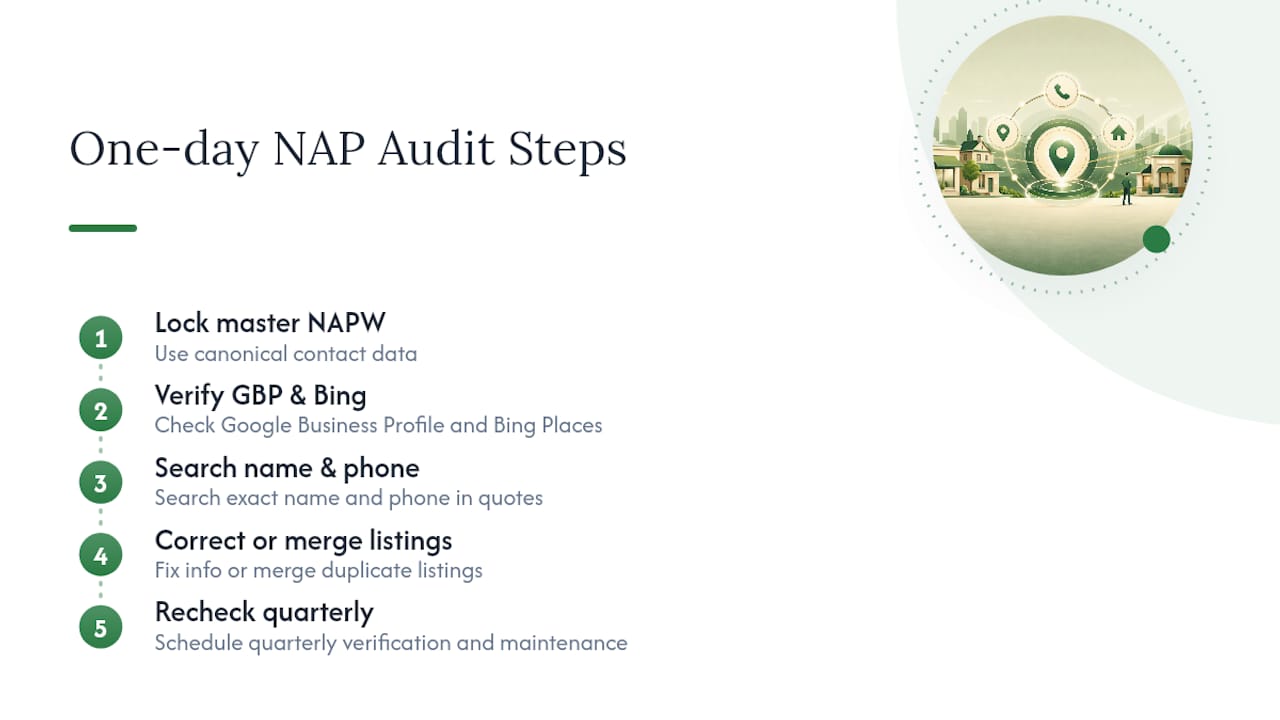
A short checklist worth handing to whoever manages your listings: lock the master NAPW, verify Google Business Profile and Bing Places, search your exact name and phone number in quotes, correct or merge anything that doesn't match, and recheck quarterly. If that list feels like more than your team has time for, Honey Badger's local SEO services cover the audit and the ongoing maintenance, whether you're running one location or coordinating listings for several offices, including work built out on the Scottsdale SEO and Arizona SEO pages.
Useful Platforms and Resources for Your Next Audit
The three claim pages worth bookmarking before you start any audit: Google Business Profile for the listing that carries the most local ranking weight, Bing Places for Microsoft's search ecosystem, and Apple Maps Connect for iOS and Siri visibility.
For background on why this work pays off, the Search Engine Watch survey on inaccurate listings documents the consumer trust cost directly, and SERoundtable's coverage of Google's phone number formatting is worth a read before you standardize your own number format.
If you'd rather hand the ongoing work to someone else, Honey Badger's Google Business Profile Optimization page outlines what a managed engagement covers, and the Quotewren blog on GBP reviews is a useful companion resource for handling the review side of your listing once it's verified.
Why Most Businesses Get Citation Cleanup Backwards
The conventional advice treats NAP consistency as a set-it-and-forget-it project: run one audit, fix what's broken, move on. That's backwards. The businesses that actually keep clean citations treat it the way a serious runner treats sleep, as a routine that only pays off with repetition, not a single grand effort followed by neglect.

What's overrated here is chasing every minor directory on the internet. Nobody needs to hunt down NAP mismatches on a directory that sends zero traffic. What's underrated is the phone number audit specifically. Address typos annoy customers; a dead or mistracked phone number costs you the call entirely, and most businesses never think to search their own number in quotes to see where it still shows up wrong.
If you do only one thing after reading this, do the platform trio first. Google Business Profile, Bing Places, and Apple Maps Connect cover the overwhelming majority of how customers actually find and call local businesses. Everything else, the aggregators, the niche directories, the old citation sites, matters, but it matters less. Fix the big three, build the habit of checking quarterly, and the smaller inconsistencies stop compounding into lost calls.
— Anas
Sources
- Google Business Profile
- Bing Places
- Apple Maps Connect
- Search Engine Watch - survey on consumer trust and inaccurate local listings