
Winning at multi location SEO starts with data, not keywords: get your business name, address, and phone number identical everywhere it appears, and build one authoritative page per real location. Skip the tricks. In the next hour, build a master spreadsheet of every location's core data, claim and verify every Google Business Profile, and fix the single weakest location page you have. Everything else in this guide builds on those three moves.
TL;DR:
- Prioritize building a master data sheet for all locations, verifying Google Business Profiles in bulk, and fixing the weakest location page before expanding.
- Create unique, hyperlocal content for each location page, including real photos, local landmarks, and specific FAQs, to improve search rankings.
- Manage citations consistently across directories and implement SameAs schema links to verified profiles to strengthen entity signals.
- Use location-specific keywords tailored to search intent and build local backlinks through sponsorships, community coverage, and local partnerships.
- Avoid duplicate location pages, ensure accurate NAP data, and implement call and conversion tracking to prevent scaling issues.
Table of Contents
- What Is the Multi Location SEO Playbook, Step by Step?
- How Do You Create Location Pages That Actually Rank?
- How Do You Manage Google Business Profiles Across Dozens of Locations?
- Why Citations and Entity Signals Matter More Than Ever
- How Do You Collect and Manage Reviews Across Multiple Locations?
- What Site Structure Works Best for Many Locations?
- How Do You Govern a Location Page System at Scale?
- How Do You Track SEO Performance for Each Location?
- What Does a Real Multi-Location Rollout Look Like?
- Does Social Media Actually Affect Multi-Location Local Rankings?
- How Do You Handle Location-Specific Keywords and Search Intent?
- What Local Link Building Strategies Work for Multiple Locations?
- What Actually Breaks When Brands Scale Past 10 Locations
- How Honey Badger SEO Runs This Playbook for You
- Sources
What Is the Multi Location SEO Playbook, Step by Step?
Multi location SEO is the practice of getting each of a brand's physical locations to rank in its own local search results, which is fundamentally different from single-location SEO because you're managing dozens or hundreds of overlapping signals at once instead of one. The order you tackle it in matters almost as much as the tactics themselves. Do the foundational data work first, or every later step inherits the same errors.
-
Build the master data record. Before touching a single page, capture NAP (name, address, phone), hours, service lists, driving directions, staff names, and unique local facts for every location in one spreadsheet or database. This becomes the single source of truth that every template, citation, and GBP listing pulls from.
-
Claim and verify every Google Business Profile. For brands with ten or more locations, bulk verification through Google's bulk-upload process cuts the administrative grind dramatically compared to verifying one by one.
-
Design one authoritative location page template. Build a modular template with placeholders for address, staff, photos, and local content, then populate it from your master sheet rather than writing each page from scratch.
-
Implement LocalBusiness schema with SameAs links. Every location page should carry structured data that points back to verified GBP, Facebook, and industry directory profiles.
-
Run a citation audit and fix inconsistencies. Pull every existing citation across data aggregators and directories, then correct anything that doesn't match your master sheet exactly.
-
Set up review acquisition and response SOPs. Standardize how each location asks for reviews and how a central team (or trained local staff) responds.
-
Wire up tracking before launch, not after. UTM parameters and call tracking need to exist from day one so you can attribute results to the right location.
-
Establish governance rules. Decide who can create a new location page, who approves changes, and how you retire or merge underperforming pages.
The rationale behind this order is simple: schema and citations are only as good as the data behind them, and tracking is worthless if you don't know which location generated the click. Get steps one and two wrong, and steps three through eight amplify the mistake across every location instead of fixing it.
How Do You Create Location Pages That Actually Rank?
Every location page needs to do one job: prove to a searcher and to Google that this specific facility is a real, distinct business worth visiting. A generic template with the city name swapped out doesn't do that job. A Wiideman study summarized by BrightLocal found that adding hyperlocal content to location pages produced a large lift in rankings compared to generic pages, which tells you exactly where the effort should go.
Each page needs these blocks, minimum:
- NAP block matching your master sheet exactly, including suite numbers and abbreviations
- Hours of operation, with holiday exceptions noted
- A specific service list for that location, not the brand's full national menu
- An embedded map and driving directions from major nearby landmarks
- Original photos of the actual storefront, staff, and interior, not stock images
- Staff bios or team photos for that specific location
- A short FAQ addressing location-specific questions (parking, accessibility, walk-ins)
Hyperlocal content is what separates a page that ranks from one that sits on page three. Mention the shopping center you're next to, the neighborhood name locals actually use, a case study from a customer in that city, or a community event you sponsored. Local images and social links tied to a specific location also improve engagement and visibility beyond what generic photography delivers.
Pro Tip: Write one paragraph per location page that could only be true of that one facility. If you could copy-paste it onto a different location's page without changing a word, delete it and start over.
Merge two pages into one only when they genuinely serve the same market with no meaningful distinction, like two suites in the same office park. Creating separate pages for locations three miles apart in the same city usually causes them to compete against each other in search results instead of each winning its own space. Canonicalize any near-duplicate pages, keep your sitemap current as locations open and close, and submit updated sitemaps whenever you add a batch of new pages.
How Do You Manage Google Business Profiles Across Dozens of Locations?
GBP is where most of your local visibility gets decided, and managing it at scale requires a different process than managing one listing.
- Verify in bulk once you cross roughly ten locations. Google's bulk verification process exists specifically for this, and it saves weeks of one-by-one phone or postcard verification.
- Pick one primary category per location and stay consistent across the brand unless a specific location genuinely offers a different core service.
- Use every relevant attribute (wheelchair accessible, free parking, appointment-only) since these attributes influence which searches trigger your listing.
- Set up service-area settings correctly if a location doesn't have a public storefront. Google's own guidance requires hiding the street address for pure service-area businesses, but physical proximity still influences local rankings even when the address is hidden.
- Sync GBP data to your website automatically where possible, so a phone number change in the master sheet updates both instead of drifting apart.
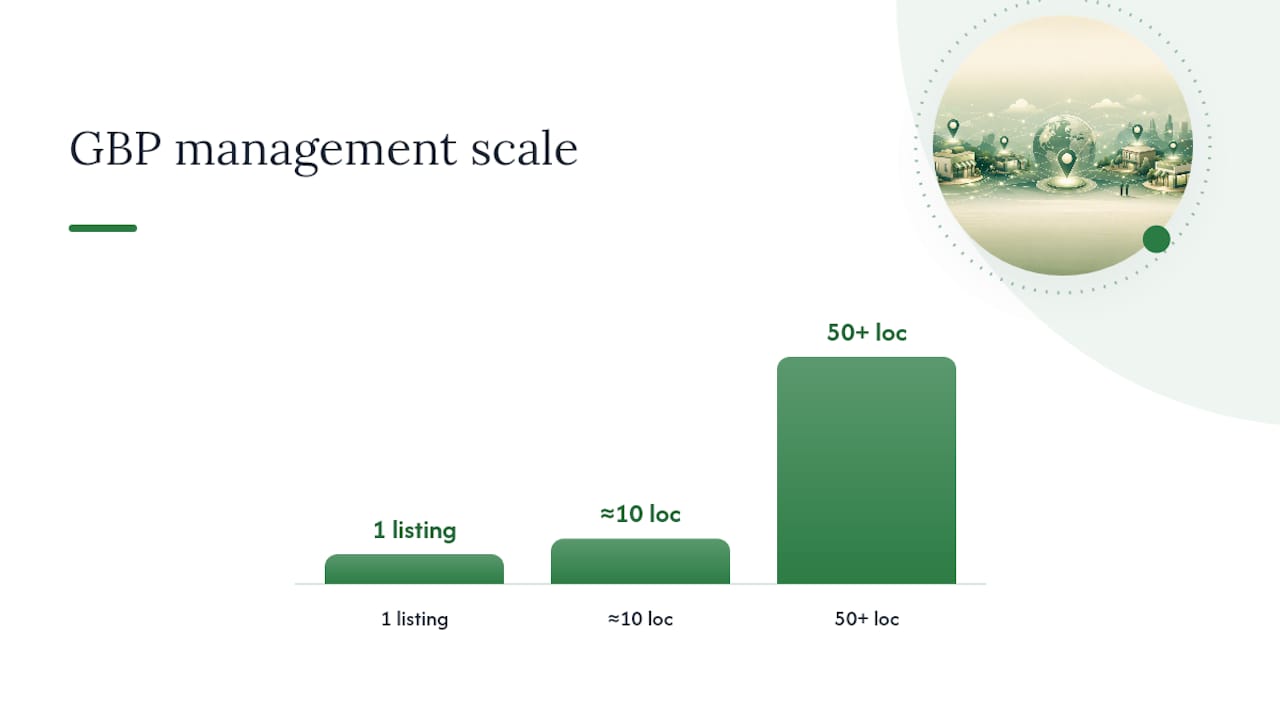
For 50 or more locations, manual GBP management stops being realistic. Use API-driven tools or a management platform that pushes posts, photos, and hour changes to every profile from one dashboard.
Pro Tip: Assign one person to review GBP Q&A and photo submissions weekly across all locations. Unanswered questions and outdated photos sitting on a listing quietly erode trust with both searchers and Google.
Why Citations and Entity Signals Matter More Than Ever
Search engines and AI assistants both need corroboration before they'll trust and recommend a business. A single accurate NAP on your website means little if ten directories list a disconnected phone number or a former address. Consistency across every mention is what builds the "entity signal" that both Google's local algorithm and AI-driven recommendation engines rely on.
- Distribute your master data automatically to major aggregators rather than updating each directory by hand
- Prioritize niche, industry-specific directories over generic ones. A dental practice benefits more from a dental association directory than a general business listing site
- Implement SameAs schema linking each location page to its verified GBP, Facebook, and directory profiles
- Audit citations quarterly and fix drift before it compounds across dozens of locations
AI-driven recommendation engines specifically favor consistent entity signals, and SameAs schema linking to verified third-party profiles is one of the clearest ways to strengthen that signal. Trust, at this point, functions as the real ranking currency: consistent NAP and quality third-party corroboration now outweigh keyword density as a ranking input for local results.
How Do You Collect and Manage Reviews Across Multiple Locations?
Review volume and quality per location shape both rankings and conversion rates, so the process needs to work the same way at location one and location one hundred.
- Give every location a unique, one-click review link (a QR code on the receipt or a text-message link works well)
- Centralize monitoring in one dashboard so no location's reviews go unanswered for weeks
- Build response templates for common scenarios, then let local managers personalize them slightly rather than copy-pasting verbatim
- Embed a rotating selection of reviews directly on each location page and mark them up with structured review data
- Never incentivize reviews with discounts or offer to write reviews on a customer's behalf. Both violate platform policies and erode the trust signal you're trying to build
Pro Tip: Ask for the review at the moment of highest satisfaction, not three days later in an automated email. A technician asking in person after a completed job converts far better than a generic follow-up blast.
Reviews aren't just a trust signal for humans. They're also content. A well-written, specific review mentioning a service and location adds exactly the kind of hyperlocal detail that generic template copy can't fake.
What Site Structure Works Best for Many Locations?
Most brands should keep every location page in subfolders under one domain (yoursite.com/locations/city-name) rather than spinning up separate domains or subdomains. Subfolders consolidate authority in one place instead of splitting it across properties that each start from zero. Separate domains only make sense when locations operate as genuinely distinct brands with different names or ownership structures.
- Build a clear hub structure: brand homepage → region page → location page → service page
- Link locations to their region page and region pages back to the brand hub, so authority flows both directions
- Canonicalize aggressively. If two URLs could serve the same search intent, pick one and redirect the other
- Keep your sitemap current and segmented by location batch if you have hundreds of pages
The guiding principle, per Search Engine Land's structure guidance, is to publish the smallest number of pages that accurately represent your real-world locations, markets, and services. More pages isn't more visibility. It's often just more competition between your own URLs.
How Do You Govern a Location Page System at Scale?
Systems break down without ownership. Someone needs to know exactly what fields live in the master sheet, who can create a new location page, and what happens when a location closes.
- Maintain one master spreadsheet or database with every field: NAP, hours, staff, unique content notes, schema status, citation status, and a change log timestamp for every edit.
- Set explicit creation criteria. A new location page gets built only when a location has a real, staffed, public-facing presence, not simply because a franchise agreement was signed.
- Define retirement and merge rules in advance. When a location closes, redirect its page to the nearest active location rather than leaving a dead page indexed.
- Use programmatic templating with human QA checkpoints. Scaling location pages requires tokenized fields pulled from a master sheet, validated by a person before publishing, not just an automated dump.
- Assign clear roles. Corporate owns the template, schema, and brand voice; local managers own reviews, local photos, and Q&A responses within corporate guardrails.
Pro Tip: Keep a change log column next to every row in your master sheet. When a listing drifts out of sync six months later, you want to know exactly what changed and when, not just that something's wrong.
The tension every brand runs into is automation versus accuracy. Automate distribution and templating. Never automate away the human review that catches the address that's one digit off.
How Do You Track SEO Performance for Each Location?
You can't manage what you can't attribute, and attribution is where most multi-location programs fall apart quietly.
- Build a consistent UTM naming convention tied to a location ID, applied to every GBP link, social post, and campaign
- Choose a call-tracking number that displays dynamically on your website but never replaces the number listed on your GBP profile or citations, since a mismatch there damages the exact consistency you've worked to build
- Feed UTM and call data into one central dashboard tracking local pack visibility, impressions, calls, form conversions, and revenue by location
- Run structured experiments: A/B test a page template change across a sample of locations, or compare GBP post frequency against call volume, before rolling a change out everywhere
Consistent UTMs paired with call tracking feeding a central dashboard is what turns "we think SEO is working" into "location 14 generated 38 tracked calls this month." That distinction is what lets you defend or reallocate budget with real numbers instead of a gut feeling.
What Does a Real Multi-Location Rollout Look Like?
A hands-on rollout from ten locations to a hundred usually follows the same sequence: full data inventory, bulk GBP verification, template build with QA, citation sync across priority directories, review-flow setup per location, then dashboard-based measurement before scaling further.
When evaluating any agency or in-house program handling this work, ask for specific deliverables:
- A master data export you own, not one locked inside a vendor's proprietary tool
- A canonical list of every live location URL and its verification status
- Direct dashboard access showing calls, conversions, and visibility by location, not a monthly PDF summary
- QA reports showing what was checked before pages or listings went live
- Anonymized performance data or client case evidence backing up the claims
Honey Badger SEO's Google Business Profile management service and Scottsdale SEO work follow this same sequence for clients scaling past their first few locations, with clients retaining ownership of every asset built along the way.
Does Social Media Actually Affect Multi-Location Local Rankings?
Social media doesn't move local rankings directly the way a citation or a review does, but it feeds the entity and trust signals that do. Each location needs its own social presence, or at minimum its own tagged location page within a centrally managed profile, so that check-ins, tags, and local engagement tie back to the correct address.
A single national social account can't generate location-specific engagement signals, and it can't be the target of a SameAs link pointing from an individual location page. Set up a Facebook location page (not just a post) for each site, keep Instagram location tags accurate, and make sure any local promotions or events get posted from the account tied to that specific address.
The SEO payoff shows up in two places. First, social profiles are exactly the kind of verified third-party link that strengthens entity signals when connected through SameAs schema. Second, local engagement, comments, shares, and check-ins from people physically near a location send a real-world relevance signal that generic corporate posting never generates.
Don't treat this as a content calendar exercise run entirely from headquarters. Give local managers light editorial control over their location's page, with corporate setting brand guardrails, and you'll get content that actually reflects the neighborhood instead of a template with the city name swapped in.
How Do You Handle Location-Specific Keywords and Search Intent?
Search intent shifts by geography more than most brands assume. "Best insulation contractor near me" and "insulation contractor [city name]" can trigger different result sets, and searchers in a suburb often use neighborhood names Google itself doesn't recognize as official.
Start keyword research at the location level, not the brand level. Pull search terms from Google Search Console filtered by page, and look for neighborhood names, local landmarks, or regional service terms customers actually type. A location page targeting "emergency plumber Scottsdale" needs different on-page emphasis than one targeting "affordable plumber Scottsdale," even though both are plumbing searches in the same city.
Map intent to page sections rather than stuffing keywords into a single paragraph. Informational intent (what services are offered) belongs near the top. Transactional intent (book now, call now) belongs in the header and a persistent call-to-action. Local comparison intent (why this location versus a competitor) belongs in the reviews and hyperlocal content sections.
Avoid the trap of writing every location page around the exact same head keyword. If your service list, price point, or specialty differs by location, let the keyword targeting differ too. A location near a business district might rank better and convert better around commercial service terms, while a suburban location leans into residential language.
What Local Link Building Strategies Work for Multiple Locations?
Link building for one location doesn't scale simply by repeating the same tactic across every city. Each location needs its own local link profile built from sources that only make sense in that specific market.
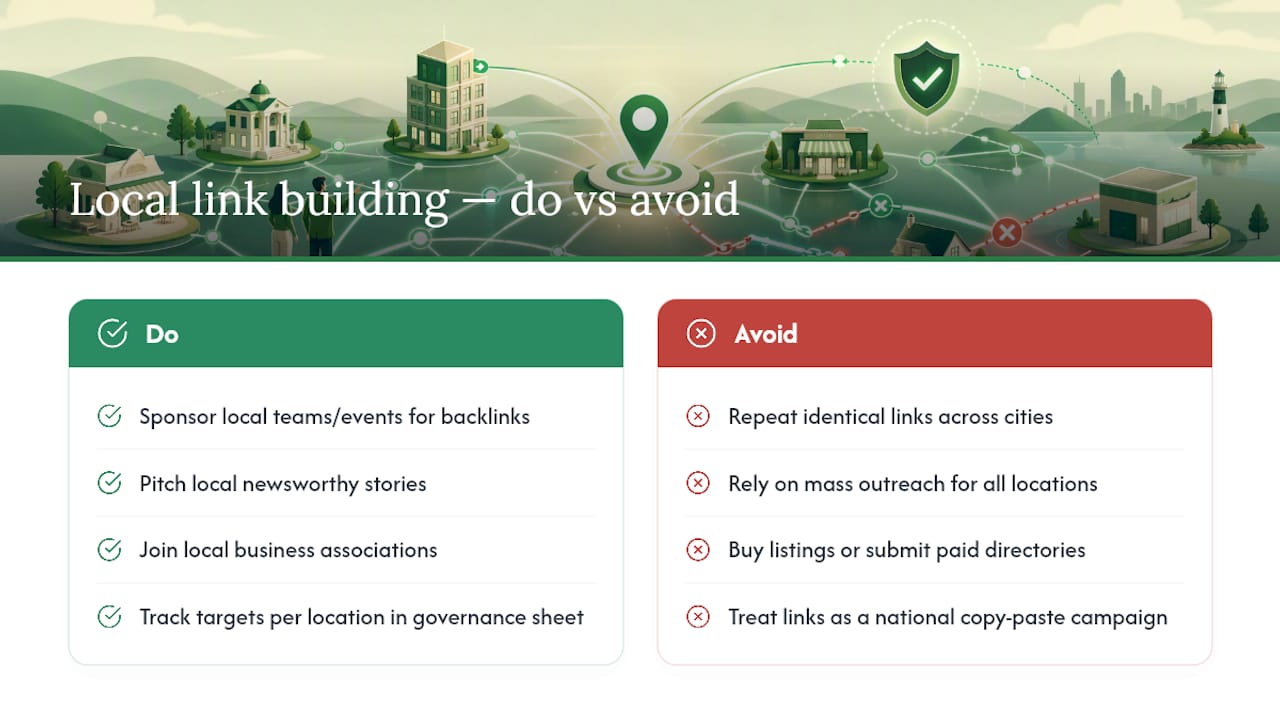
Start with local sponsorships and chamber of commerce memberships. Every location that sponsors a little league team, a school fundraiser, or a local charity event earns a legitimate, geographically relevant backlink from that organization's website, and these links carry real local trust that a national directory link never will.
Local news coverage is another underused source. A location opening, a community event, or a milestone (tenth anniversary, new hire, award) is genuine local news that a regional outlet may cover, generating a link no competitor can easily replicate. Local business associations, industry-specific regional directories, and partnerships with complementary (non-competing) local businesses round out a realistic link profile.
Resist the urge to build the exact same link at every location through mass outreach or paid directory submissions. That pattern is detectable and it doesn't build the kind of local trust signal that actually moves rankings. Assign link building targets by location, track them in your master governance sheet alongside citations, and treat each location's link profile as its own small project rather than one national campaign copy-pasted across a spreadsheet of cities.
What Actually Breaks When Brands Scale Past 10 Locations
The three mistakes that show up over and over: duplicate or near-duplicate location pages competing against each other, NAP data that drifted out of sync across citations nobody's audited in a year, and zero call or conversion tracking tied to individual locations. Fix those three before anything else. If you're choosing where to spend limited hours this quarter, a citation audit, a hyperlocal content pass on your five weakest pages, and basic call tracking will outperform almost any other single investment.
Automation earns its place in distribution and templating. It has no place in the final QA check before a page or listing goes live. The brands that scale cleanly are the ones that never let a spreadsheet publish something a human hasn't verified.
— Anas
How Honey Badger SEO Runs This Playbook for You
Running this system in-house across dozens of locations eats a full-time employee's calendar fast: citation audits, GBP posting, review responses, and page QA never actually stop. Honey Badger SEO is the alternative to a traditional agency retainer for local service brands managing more than one location. Every deliverable, from your master data sheet to your citation list, stays yours to keep even if you ever leave.
The service covers Google Business Profile setup, verification, and ongoing GBP management, location page architecture and hyperlocal content, citation cleanup across directories, and call and form tracking wired up per location from day one. Every client works with Honey Badger SEO directly, month to month, with no long-term contract locking you in and no outsourced work handled by an unnamed subcontractor. Brands operating in Arizona can see the approach applied at Arizona SEO, and California-based multi-location brands can review the Orange County SEO service page for a sense of scope.
To start, request an audit and include your current location count, a link to each existing GBP listing, and your biggest current pain point (rankings, review volume, or tracking gaps). That's enough for a real assessment of where your program stands through Honey Badger SEO's local SEO services.
Sources
- Multi-location SEO | BrightLocal
- Multi-Location SEO: How To Win Google & AI Search Visibility At Scale — Search Engine Journal
- Multi-location SEO: How to structure geographic pages at scale — Search Engine Land
- Multi-Location SEO: How to Scale Without the Chaos — Backlinko