
Most local businesses pay between $500 and $5,000 per month for managed local SEO, with one-time projects landing in that same $500 to $5,000 range and hourly consulting running $75 to $200 or more. The biggest swing factor is competition, followed by how many locations you're optimizing and how much work your site and Google Business Profile need. Expect early movement in 4 to 8 weeks, but real lead growth usually takes 3 to 6 months.
TL;DR:
- Local SEO costs vary mainly based on industry competition and the number of locations, with high-value sectors like legal paying up to $5,000 monthly.
- Most small businesses can expect to spend between $400 and $2,000 per month for comprehensive management, depending on local market competitiveness.
- Upfront project fees range from $500 to $5,000 for audits or setup, while hourly consulting averages $75 to $200 per hour for strategic guidance.
- Price differences are justified by factors such as site technical health, industry demand, and local search volume, not vendor markup.
- Transparency and scope clarity remain key; vendors should clearly specify deliverables and own their work without outsourcing behind the scenes.
Table of Contents
- How Much Does Local SEO Cost? Typical Pricing Ranges
- What Drives Local SEO Cost Up or Down?
- Which Local SEO Pricing Model Fits Your Business?
- What Do You Actually Get at Each Price Point?
- Sample Local SEO Budgets by Business Size and Industry
- How to Evaluate a Local SEO Proposal Without Getting Burned
- Honey Badger SEO: Transparent, Month-to-Month, Hands-On
- How Location Changes What You'll Pay for Local SEO
- DIY Local SEO vs. Hiring an Agency: What's the Real Trade-Off?
- What I'd Tell a Business Owner Setting This Budget
- Get a Scoped Local SEO Quote From Honey Badger
- Sources
How Much Does Local SEO Cost? Typical Pricing Ranges
Ask five agencies for a quote and you'll get five different numbers, but they tend to cluster around a few recognizable bands once you strip away the sales language.
Monthly retainers are the dominant billing model, and they roughly break into four tiers. Automated or software-driven tools sit at the bottom, often $100 to $500 per year for basic citation and listing management with no human strategy behind it. Small-business packages typically run $400 to $900 per month and cover Google Business Profile upkeep, a handful of citations, and light content work. Comprehensive packages, the tier most competitive local businesses actually need, land between $900 and $2,000 monthly. Enterprise or multi-location programs push past $2,000 and can climb well beyond that depending on the number of markets involved, according to Hennessey's local SEO cost breakdown.
One-time projects follow a different logic. A technical audit, a Google Business Profile setup and verification, or a batch of on-page fixes typically costs $500 to $5,000 depending on how broken things are when the agency starts. Hourly consulting, meanwhile, runs $75 to $200 or more per hour, which makes sense for a business that needs a one-time strategy session rather than ongoing management.
Here's how those bands typically map to real deliverables:
- $400–$900/month: GBP monitoring, a few citation fixes, minimal reporting.
- $900–$2,000/month: Full GBP management, content updates, link outreach, monthly strategic review.
- $2,000+/month: Multi-location oversight, dedicated account management, competitive link building, custom reporting dashboards.
- $500–$5,000 one-time: Audits, GBP setup and verification, or a technical cleanup project.
Some managed services skip the tiered approach entirely and charge a single flat rate. One well-known example bundles GBP management, citation work, content, and technical fixes into a $1,299 monthly package with built-in reporting. That kind of packaging tells you something important: predictable pricing is achievable in this industry when a vendor is willing to define scope tightly rather than quoting by the hour and hoping you don't ask questions.
Statistic worth remembering: pricing gaps of up to 8 times between industries are common, and they almost always trace back to keyword competition, not vendor markup.
What Drives Local SEO Cost Up or Down?
Price variation in this industry isn't random. It follows a handful of predictable levers, and understanding them lets you spot a fair quote from an inflated one.
Competitor density and keyword value matter more than anything else. A personal injury attorney competing against a dozen well-funded firms in a metro area faces a completely different cost structure than a single dry cleaner in a small town, even though both are technically buying "local SEO." That gap explains most of the 8x price variation you'll see between industries.
Number of locations scales cost almost linearly. Each additional location typically needs its own Google Business Profile, its own citation cleanup, and often its own landing page. An agency managing five locations isn't doing five times the strategic thinking, but it is doing real per-location work that adds up.
Other factors that move the price:
- Industry demand and customer lifetime value. Legal and dental practices pay more because a single converted client is worth thousands, which justifies aggressive investment.
- Technical debt. A site built on an outdated platform with broken schema markup or duplicate location pages costs more to fix upfront than a clean, modern build.
- Content needs. Businesses with thin or outdated service pages need more content production, which adds hours regardless of billing model.
- Third-party tool and link costs. Rank tracking software, citation management platforms, and legitimate local link acquisition all carry real costs that agencies pass through in some form.
Pro Tip: Ask any vendor how much of your monthly fee goes to tools and outreach versus hands-on strategy work. A vendor who can't answer clearly is probably reselling a generic package, not building something specific to your market.
Scope creep is the quiet cost driver nobody mentions upfront. A quote that looks cheap in month one can balloon once the agency discovers your GBP was never verified, your NAP data is inconsistent across 40 directories, or your site has no location pages at all. Ask for a technical snapshot before you sign anything.
Which Local SEO Pricing Model Fits Your Business?
Four billing structures dominate this industry, and each one suits a different kind of business.
- Monthly retainer. The most common model. You pay a fixed or semi-fixed fee for ongoing work: GBP management, content, citations, and reporting. It suits businesses that understand SEO compounds over time and want steady, predictable spend rather than a one-time fix.
- Project-based fees. You pay once for a defined deliverable, like a technical audit or a GBP setup and cleanup. This model works well for businesses that already have some SEO foundation and just need a specific gap closed.
- Hourly consulting. Best for businesses that want strategic guidance without handing over execution. You're paying for expertise, not labor volume, which makes it a poor fit for ongoing citation building or content production.
- Performance-based pricing. Rare, and worth approaching carefully. Some vendors tie fees to ranking positions or call volume. It sounds appealing, but it often incentivizes short-term ranking tricks over sustainable growth, and it's genuinely hard to structure fairly for either side.
Hybrid arrangements are increasingly common: a setup or audit fee upfront, followed by a lower monthly retainer once the technical foundation is fixed. That structure lets businesses avoid overpaying for a full-service retainer before the site is even ready to rank.
What Do You Actually Get at Each Price Point?
Price alone tells you almost nothing. What matters is the deliverables list behind the number, because two agencies charging $1,000 a month can offer wildly different scopes of work.
At the entry tier ($400–$900/month), expect basic GBP monitoring, a round of citation corrections, and minimal reporting, often just a screenshot of rankings once a month. This tier suits low-competition businesses in small markets that need maintenance, not aggressive growth.
At the mid tier ($900–$2,000/month), the deliverables expand meaningfully: full GBP optimization including posts and review responses, ongoing content creation for service and location pages, citation building beyond the basics, and a real link acquisition effort. You should also see a monthly strategic review, not just a raw data dump. One packaged example at this tier bundles a dedicated account manager, monthly reporting, and technical fixes into a single fixed price.
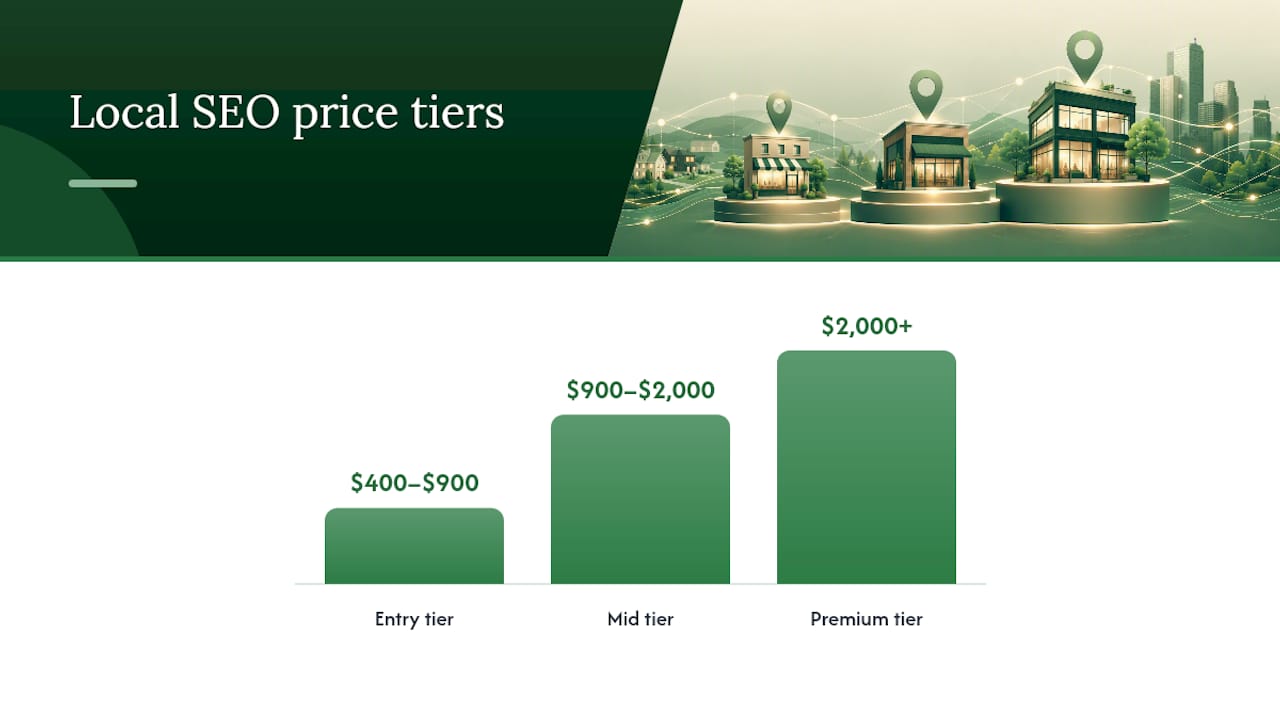
At the premium tier ($2,000+/month), expect multi-location management, custom content strategy tied to specific service lines, competitive link building against named competitors, and detailed dashboards tracking calls, form fills, and ranking movement by location.
Regardless of tier, a handful of things should be non-negotiable:
- Rank tracking for your priority keywords, updated monthly at minimum.
- Call and form tracking so you can see which leads actually came from search.
- GBP insights showing views, searches, and actions taken on your profile.
- Ownership of your assets. You should own your GBP, your domain, and your content outright, not lease access to them.
Any vendor unwilling to show you a sample report before you sign is telling you something about how they'll handle transparency later.
Sample Local SEO Budgets by Business Size and Industry
Numbers get more useful once you attach them to a business you recognize. Here's how budgets tend to break down in practice.
A micro-business with 1 to 10 employees, think a single hair salon or a two-truck plumbing outfit, typically budgets $400 to $900 per month. That covers GBP management, basic citations, and light content, enough to compete in a low-to-moderate competition local market.
A single-location small business in a moderately competitive market usually lands in the $900 to $2,000 range, especially if the owner wants steady lead growth rather than just maintenance.
Higher-competition verticals command noticeably higher budgets. According to industry benchmark data, typical monthly ranges look like this:
- Legal: $2,500–$5,000
- Dental and healthcare: $1,500–$4,000
- Home services (insulation, roofing, HVAC): $1,000–$3,500
- Restaurants: $500–$1,500
- Photography and small creative services: $300–$600
Multi-location businesses rarely pay a simple multiple of the single-location rate. A five-location home services company might reasonably budget $3,500 to $6,000 monthly total, not $10,000 or more, if the agency is managing efficiencies across locations correctly.
How to Evaluate a Local SEO Proposal Without Getting Burned
Comparing proposals side by side only works if you force them into the same shape first. Most vendors write quotes designed to be hard to compare.
- Ask exactly what's included, in writing. Get a deliverables list, not a vague description like "ongoing optimization."
- Ask who does the actual work. Many agencies outsource execution to overseas contractors or subcontractors, which affects both quality and communication speed.
- Ask for sample reports. A legitimate vendor can show you rank tracking, call tracking, and GBP insights from an existing client (redacted, of course) without hesitation.
- Ask about contract length and cancellation terms. Long lock-in contracts are a red flag in an industry where month-to-month accountability should be standard.
- Normalize the scope before comparing price. If one quote includes content and another doesn't, add estimated content costs to the cheaper quote before you compare totals.
Pro Tip: Request the same three deliverables from every vendor you're considering — a technical audit summary, a sample monthly report, and a citation list. Vendors who can produce all three quickly are usually the ones actually doing the work themselves.
Watch for vague language like "we optimize your presence" with no specifics attached. That phrasing usually means there's no real strategy behind the invoice.
Honey Badger SEO: Transparent, Month-to-Month, Hands-On
Seohoneybadger runs on a flat, month-to-month local SEO retainer built around three pillars: search optimization, website builds designed to rank and convert, and full Google Business Profile management, covering setup, verification, ongoing posting, and review strategy. There's no long-term contract to escape from and no outsourced work happening behind the scenes.
That last point matters more than it sounds. When one person handles your technical audits, your citation cleanup, and your GBP posting directly, accountability doesn't get lost between account managers and subcontractors. Every piece of scope, from service and location page architecture to link building, stays visible and traceable back to the person doing it. For a business owner comparing quotes, that transparency is the difference between a proposal that reads well and one that actually holds up month after month.
How Location Changes What You'll Pay for Local SEO
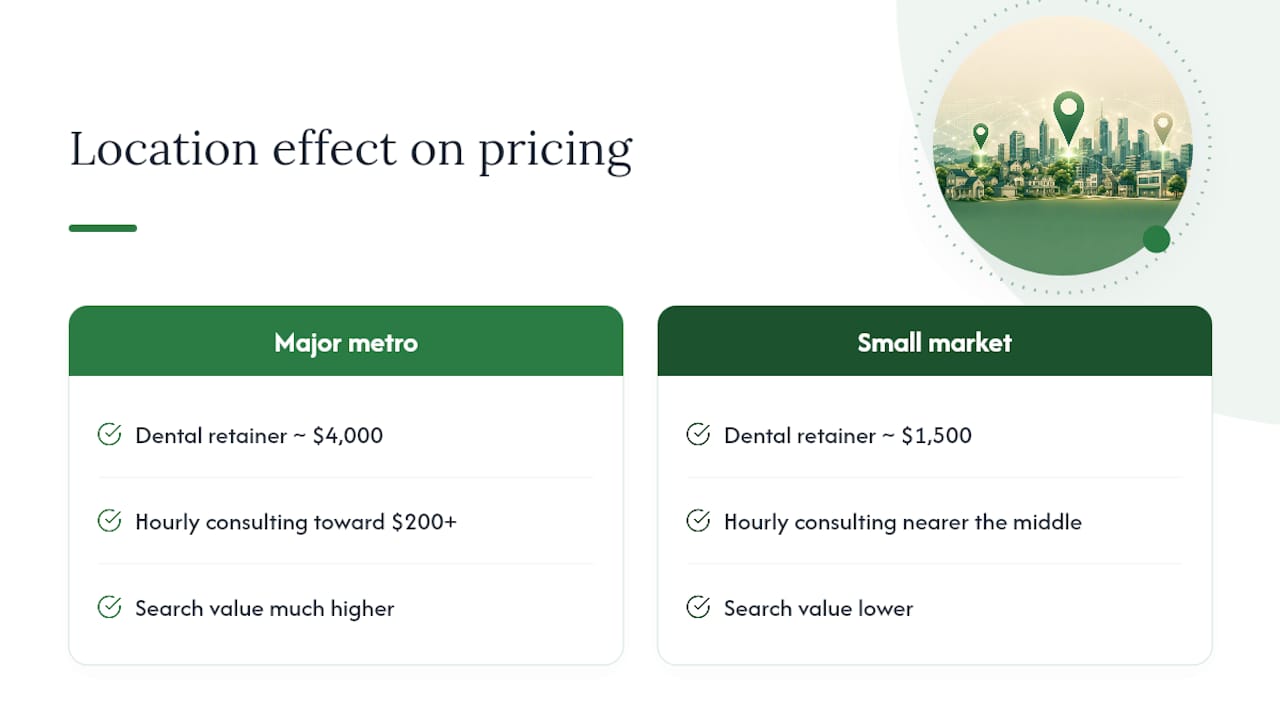
Local SEO pricing shifts by geography for reasons that have nothing to do with the vendor's skill level. Markets with dense competitor concentration and high customer lifetime value push prices up regardless of business size. A dental practice in a major metro area competes against dozens of well-funded rivals for the same handful of map-pack spots, which drives monthly budgets toward the $4,000 end of the healthcare range, while the same practice in a smaller market might comfortably compete at $1,500.
Labor costs for agencies also vary by region, which affects hourly consulting rates more than retainer pricing, since retainers are typically scoped around deliverables rather than local wage benchmarks. A business in a major coastal metro should expect hourly consulting quotes toward the higher end of the $75 to $200+ range, while smaller-market agencies often price closer to the middle.
There's also a search-behavior factor: densely populated areas generate more search volume per keyword, which raises the value of ranking well and justifies higher spend. A single first-page ranking in a city of two million people is worth considerably more in raw lead volume than the same ranking in a town of twenty thousand, even if the optimization work required is nearly identical. That's why comparing your quote to a friend's business in a different city rarely tells you anything useful.
DIY Local SEO vs. Hiring an Agency: What's the Real Trade-Off?
DIY local SEO costs little in cash but a lot in time. Claiming and optimizing your own Google Business Profile, building citations manually, and writing your own location pages is genuinely doable for a motivated owner, and it costs close to nothing beyond your own hours.
The trade-off shows up in speed and consistency. Agencies bring systems, established citation relationships, and the experience to spot technical issues an owner might miss entirely, like duplicate GBP listings or inconsistent NAP data across directories. That expertise is exactly why comprehensive packages cost more than DIY tools: you're paying for someone who has already made the mistakes on other clients' accounts.
The realistic middle ground for many small businesses is a hybrid: handle the free, low-effort tasks yourself (claiming your GBP, responding to reviews, basic photo uploads) while hiring an agency or freelancer for the technical and content-heavy work that actually moves rankings. That approach keeps cash outlay lower without sacrificing the parts of local SEO that genuinely benefit from experience.
What I'd Tell a Business Owner Setting This Budget
If you're setting a first-time local SEO budget, don't start with "what can I afford." Start with "what does my competition already have," because that number tells you the floor you need to clear just to show up in the map pack. A $500 monthly budget in a market where three competitors are spending $2,000 isn't a starting point, it's a rounding error. My honest recommendation: pick the tightest scope you can genuinely track, verify GBP insights and call tracking are part of the deal from day one, and give it a full 3 to 6 months before judging results. Local SEO compounds; it doesn't spike.
— Anas
Get a Scoped Local SEO Quote From Honey Badger
This service is an alternative to a rigid agency contract: you get a flat, month-to-month scope built specifically around your competition, your locations, and your Google Business Profile, with no long-term lock-in if priorities change.
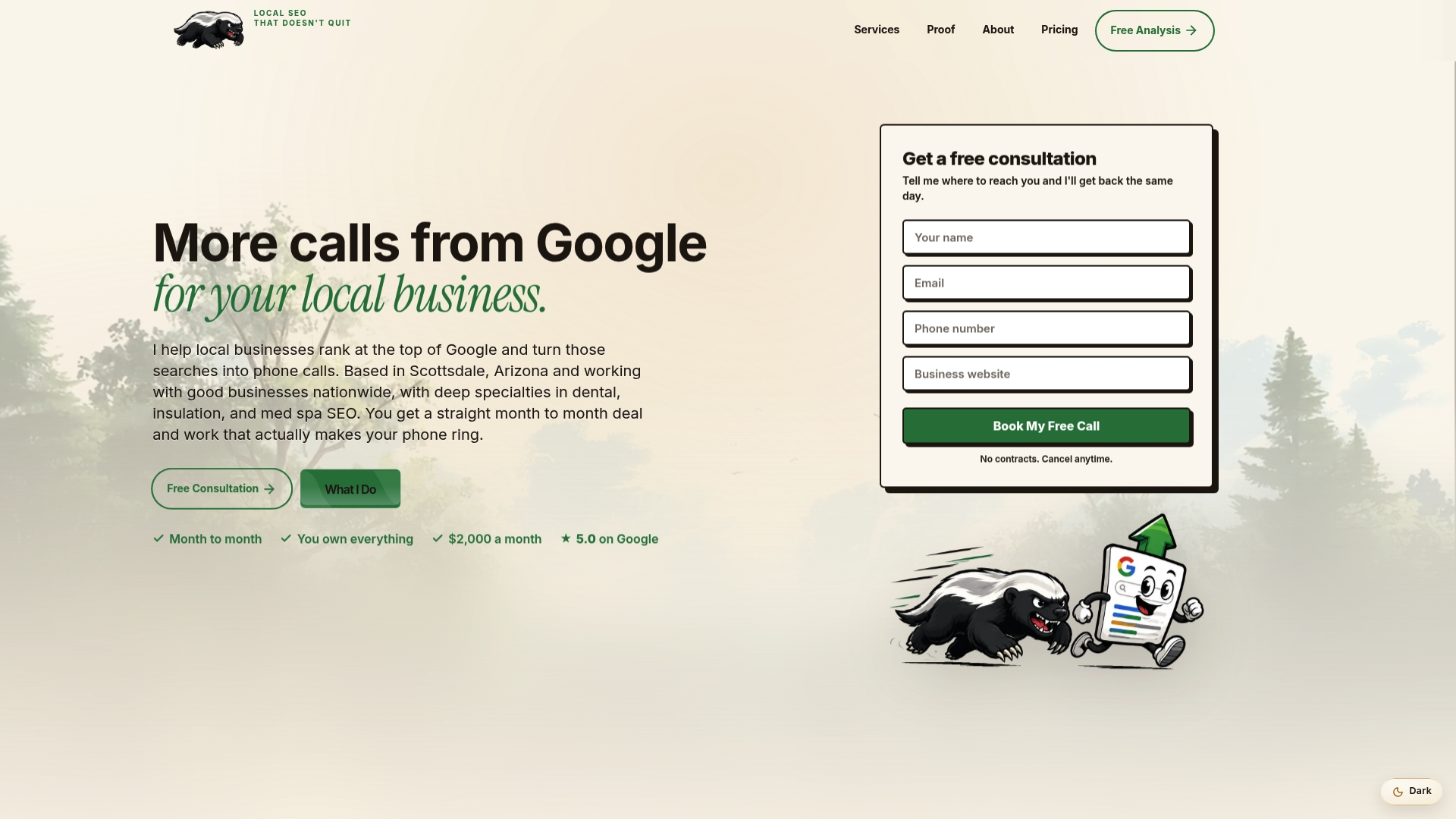
A discovery call typically covers your current GBP status, a quick look at your website's technical health, and a review of who's actually beating you in the map pack right now. To get an accurate quote, have your GBP login access ready, along with a rough list of your top three to five competitors and any past SEO reports you can share. From there, you'll get a scoped monthly number tied to specific deliverables, not a generic package pulled off a shelf.
If you're a single-location business ready to see what that looks like for your market, start with a local SEO services review or book a call directly through the Scottsdale SEO team to get a scoped number this week.
Sources
- Local SEO Budget Benchmarks by Industry: What Small Businesses Actually Pay in 2026
- How much does local SEO cost for businesses?