Local link building means earning backlinks from websites tied to your city, region, or industry community, not chasing high-authority sites with no connection to your area. Start with three moves this month: claim your chamber of commerce and industry directory listings, sponsor or partner with one local organization, and pitch a local news outlet a specific story about your business. Expect early ranking signals within 8 to 16 weeks, with real Local Pack movement taking longer.
TL;DR:
- Local backlinks from city-specific sources like newspapers, chambers, and sponsorships have a greater impact on rankings than high-authority nonlocal links.
- Building citations first ensures your business information is consistent, making subsequent local link efforts more effective.
- Pursuing relationships with familiar vendors, sponsors, or nonprofits yields higher conversion rates than cold outreach to unfamiliar sites.
- Expect to see initial ranking signals within 8 to 16 weeks, with significant Local Pack movement typically taking 4 to 9 months of sustained effort.
- Prioritizing a few highly relevant, geographically tied links—such as a local newspaper mention or a sponsorship—outperforms scattered outreach to numerous low-relevance sites.
Table of Contents
- What Is Local Link Building, and Why Does Geography Beat Raw Authority?
- What Are the Best High-ROI Local Link Building Tactics?
- How Do You Find and Prioritize Local Link Opportunities?
- How Do You Pitch for Local Links and Where Should They Point?
- How Do You Measure Whether Local Link Building Is Working?
- What Does a 90-Day Local Link Building Plan Look Like?
- How Does Honey Badger SEO Help Local Businesses Build Real Local Authority?
- Why Most Local Link Building Advice Undersells Prioritization
- Get Hands-On Help Building Local Links That Actually Convert
- Where to Learn More About Local Link Building
- Sources
What Is Local Link Building, and Why Does Geography Beat Raw Authority?
Local link building is the practice of earning editorial hyperlinks from websites that Google associates with your geographic area or your specific service niche. That's different from citations, which are structured directory listings of your business name, address, and phone number (NAP) on sites like Yelp or the Better Business Bureau. Citations confirm you exist and where. Links tell Google you're relevant and trusted by other sites in your world.
Here's the part most business owners get backwards: a link from your city's newspaper often does more for your map rankings than a link from a national blog with ten times the domain authority. Google weights geographic relevance heavily for local queries, so a local backlink frequently outperforms a higher-authority nonlocal one when the two are competing for the same "near me" search.
A few real-world examples make this concrete:
- A plumbing company gets linked in a city newspaper's "best local contractors" roundup and sees its Google Business Profile calls tick up within two months.
- A dental practice joins its local chamber of commerce, picks up a directory listing with a dofollow link, and starts showing in the map pack for a competitive nearby suburb.
- An insulation contractor sponsors a youth sports team, earns a link from the league's sponsor page, and gains a durable citation that never expires like a paid ad does.
The sequence matters. Build citations first, since inconsistent NAP data undermines everything else you do. Then layer local backlinks on top. Trying to build local links before your citations are clean is like painting a house before you've fixed the siding.
What Are the Best High-ROI Local Link Building Tactics?
Not every tactic deserves equal time. Some tactics take one phone call and pay off for years. Others eat a full afternoon and barely move the needle. Here's how to rank them by return.
1. Chamber of commerce and BID listings. Joining your local chamber of commerce or business improvement district usually costs $150 to $500 a year and gets you a dofollow link from a domain Google already trusts for local relevance. The ask is simple: pay the membership, request the directory listing, confirm the link is live. The pitfall is stopping there. Chamber links are foundational, not a finish line.
2. Local directories and citation sites. Beyond the chamber, industry-specific and city-specific directories round out your citation base. These are lower effort but also lower impact individually, so treat them as volume plays that support the bigger wins rather than the centerpiece of your strategy.
3. Local sponsorships. Sponsoring a youth sports league, a school fundraiser, or a community 5K typically earns a link from the organization's sponsor page. Costs range widely, but even a modest sponsorship, often in the low hundreds of dollars, can produce a link that stays live for years. The ask: email the event organizer, offer a sponsorship tier, and specifically request your business name link to your website.
4. Local digital PR and news coverage. Pitching a reporter at a regional outlet works best when you bring something newsworthy: a milestone, a community event you're hosting, or original local data. Hyperlocal content like neighborhood guides tends to earn coverage because reporters need local angles, not generic press releases.
5. Local resource pages. City government pages, public library resource lists, and school district vendor pages often maintain curated link lists. A landscaping company might land on a city's "approved contractors" page. The ask is a short, polite email asking to be added, with your relevant credential attached.
6. Partner, vendor, and customer pages. If you supply materials to other local businesses or get supplies from a distributor, ask whether they list partners or vendors on their site. This is one of the easiest wins because the relationship already exists.
7. Community and nonprofit links. Volunteering with or donating to a local nonprofit often results in a link on their supporters or partners page. These links carry goodwill along with SEO value.
8. Local guest posts on hyperlocal blogs. Smaller local blogs and neighborhood publications sometimes accept guest content from area businesses. Lower authority than a newspaper, but often easier to land and still geographically relevant.
9. Reclaim unlinked mentions. Search your business name in quotes and see where you're mentioned without a link. A quick, friendly email asking the site to add one often works, especially if you already have some relationship with them.
10. Reverse-engineer competitor backlinks. Find out where competitors in your city are getting linked and pursue the same sources. If three plumbers in your area are all listed on the same regional trade association page, that's a link you're missing.
11. Internal linking to amplify earned links. Once you land a strong link pointing to your homepage or a service page, make sure your internal linking structure pushes that authority toward the pages you actually want to rank, like your location or service pages.
Group these by effort: chamber listings, directories, and reclaiming unlinked mentions are quick wins you can knock out in a week. Sponsorships, partner pages, and competitor mining are mid-effort plays worth a month of steady work. Digital PR and resource-page outreach are higher effort but often the highest-ROI category, since a tiered approach shows that a handful of strong links outperform dozens of weak directory listings.
Pro Tip: When you're stuck choosing where to spend your next hour, pick the tactic where a relationship already exists, a vendor, a nonprofit you support, a customer you know. Warm outreach converts to links far more often than cold email ever will.
How Do You Find and Prioritize Local Link Opportunities?
Prospecting doesn't need to be complicated, but it does need a system. Random outreach wastes time; a structured audit finds the links worth chasing.
Step 1: Run a backlink audit and a citation audit. Tools like Ahrefs or Semrush show you what links you already have and what competitors have that you don't. Pair that with a citation audit through BrightLocal or Whitespark to catch missing or inconsistent NAP listings before you chase new links.
Step 2: Map your hyperlocal radius. Use Google Maps to identify chambers, business associations, schools, and nonprofits within your service area. Search operators help too: try site:.gov "your city" resources or inurl:sponsors "your city" to surface pages that link out to local businesses.
Step 3: Reverse-engineer the competition. Plug a local competitor's domain into your backlink tool and filter for links from sites in your city or region. If they're listed somewhere you're not, that's your next outreach target.
Score every opportunity on four factors before you spend time on outreach:
- Relevance: Is the site actually tied to your city or your industry?
- Likelihood of linking: Do they already link to similar businesses?
- Authority and reach: Does this site get real local traffic, not just a domain score?
- Durability: Will the link still be live in two years, or is it a one-time press mention that gets archived?
How Do You Pitch for Local Links and Where Should They Point?
Outreach doesn't need to be clever. It needs to be specific, brief, and easy to say yes to.
- Sponsorship pitch: "We'd like to sponsor [event/team] this season. Could you include our business name linked to [specific URL] on your sponsors page?"
- PR pitch: Include a short owner quote, a specific page you want linked, and a high-res photo. Journalists move faster when the legwork is already done, and pitches with these three elements get published more often.
- Partner or vendor listing: "We've enjoyed working with [company] this year. Would you be open to listing us on your partners page? Happy to return the favor."
- Unlinked mention reclamation: "Thanks for mentioning [business name] in your recent article. Would you mind adding a link to [URL] for readers who want to find us?"
Follow up once after 5 to 7 days, then send a final polite reminder after 10 to 14 days. After that, move on. Point links toward optimized location or service pages, not your homepage, since those pages carry the specific content and schema markup Google needs to connect the link to a real local intent. Before pitching, make sure the target page has clear contact information, local schema, and content specific to that neighborhood or service area.
How Do You Measure Whether Local Link Building Is Working?
Track four numbers: your Local Pack ranking for target keywords, Google Business Profile actions like calls, direction requests, and website clicks, organic rankings for "near me" and city-specific phrases, and referral traffic coming directly from the links you've earned.
Expect early signals, small ranking shifts and a bump in referral clicks, within 8 to 16 weeks. Meaningful Local Pack movement usually takes 4 to 9 months of consistent link and citation work, and the effect compounds the longer you stay consistent.
Monitor new and lost links with Ahrefs or Semrush alerts, track citation consistency through BrightLocal or Whitespark, and watch GBP Insights alongside GA4 for the conversion side. No single metric proves a link campaign worked on its own. Combining GBP actions, call volume, and keyword movement gives a far more honest picture than watching your link count climb in isolation. Also don't dismiss nofollow links or unlinked brand mentions. They still contribute to referral traffic and visibility, even without passing direct ranking credit.
What Does a 90-Day Local Link Building Plan Look Like?
Treat this as a sequence, not a checklist to finish in one sitting.
- Week 1: Run a full backlink and citation audit. Check your Google Business Profile for accuracy. Fix any NAP inconsistencies you find across directories.
- Weeks 2 to 6: Claim your chamber and top directory listings. Sponsor or partner with one local organization. Contact five vendor or partner businesses about cross-listing. Reclaim three unlinked mentions.
- Weeks 7 to 12: Pitch two local news outlets with a specific story angle. Publish one hyperlocal linkable asset, like a neighborhood guide or local data page. Launch an ongoing outreach cadence targeting three to five new placements a month.
- Review your KPIs at the 30, 60, and 90 day marks. If sponsorships aren't converting to links, shift budget toward PR outreach or resource-page pitching instead.
Pro Tip: Don't wait until day 90 to check your citation consistency again. A new listing added in week 3 can quietly introduce a NAP mismatch that undercuts everything else you're building.
How Does Honey Badger SEO Help Local Businesses Build Real Local Authority?
Building this kind of link profile takes consistent hours every week, which is exactly the gap Seohoneybadger fills for local service businesses. The team specializes in getting local businesses found on Google through hands-on strategies built to drive phone calls and customer inquiries, not just vanity metrics.
- Every SEO task, from citation cleanup to link outreach to GBP management, is handled directly, with no outsourcing to a third party.
- Clients get a transparent, month-to-month pricing model instead of long contracts, which keeps the incentive on results.
- The operator's background spans professional sports, tech work with Google Waymo, and law enforcement training, a combination that shows up in how calmly the work handles algorithm shifts and slow months.
- Readers who want documented outcomes can review the case studies showing how this approach has played out for real client businesses.
Why Most Local Link Building Advice Undersells Prioritization
Most guides on this topic hand you a list of 25 tactics and let you figure out where to start. That's the real failure point. A business owner with four hours a week to spend on link building doesn't need 25 options, they need to know which three actually move the map pack needle before the next quarter closes.
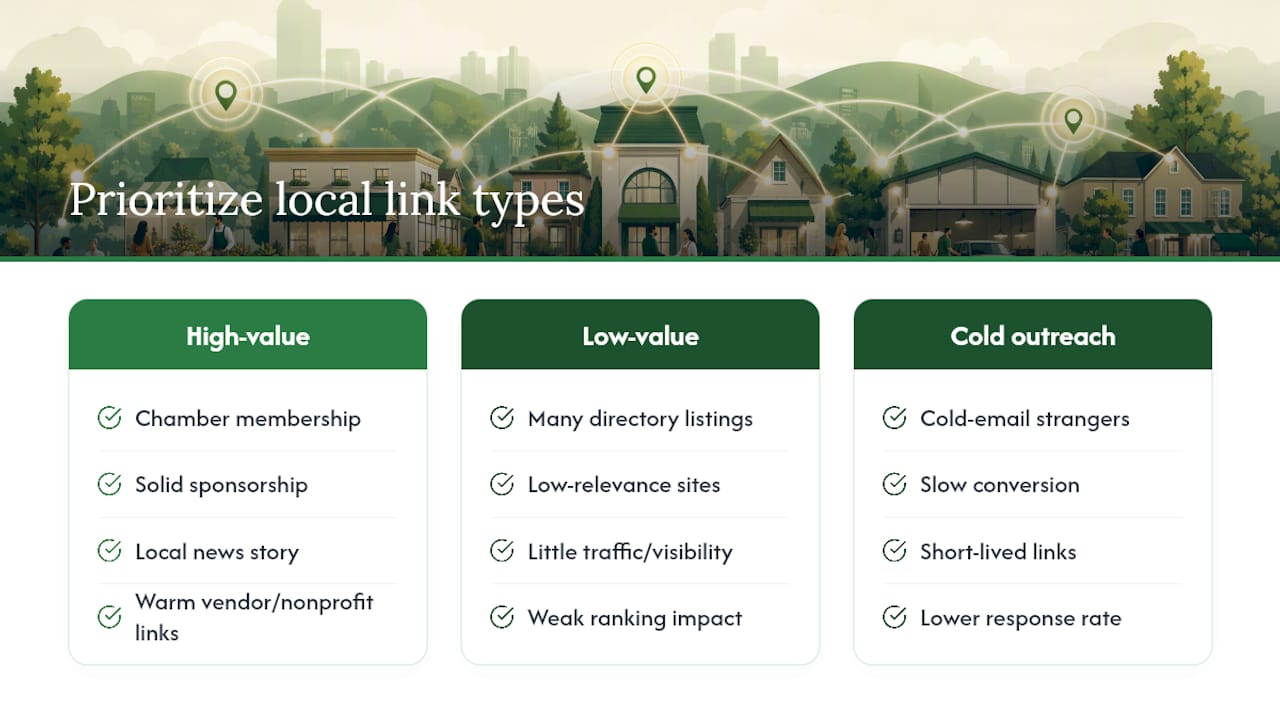
The research backs a narrower approach. A handful of strong, relevant local links tends to outperform a long tail of weak directory listings, which means chamber membership, one solid sponsorship, and a well-pitched local news story will usually beat six months of scattered outreach to low-relevance sites. The conventional advice treats every link as equally valuable if it's technically local. It isn't. A link from your city newspaper carries more weight than ten mentions on directory sites nobody visits.
If you take one thing from this playbook, prioritize relationships you already have, vendors, sponsors, nonprofits, before you cold-email strangers. Warm links convert faster and last longer.
— Anas
Get Hands-On Help Building Local Links That Actually Convert
There are alternatives to hiring a large agency or trying to DIY this yourself: a single operator manages your citations, outreach, and Google Business Profile directly, with no account handoffs and no long-term contract locking you in.
If you've read this far, you already know the tactics work, chamber listings, sponsorships, local PR, competitor link mining. What most local business owners lack isn't knowledge, it's the hours each week to execute consistently and follow up on outreach that stalls. This approach builds and monitors the pipeline directly, targeting outcomes that matter: more calls, better map pack placement, and cleaner citation data across directories. The pricing model stays month-to-month, so results are the reason clients stay, not a contract term. If you want a clear look at where your citations and local link profile stand today, request a look at your Scottsdale SEO options and see what a hands-on local link strategy could do for your call volume this quarter.
Where to Learn More About Local Link Building
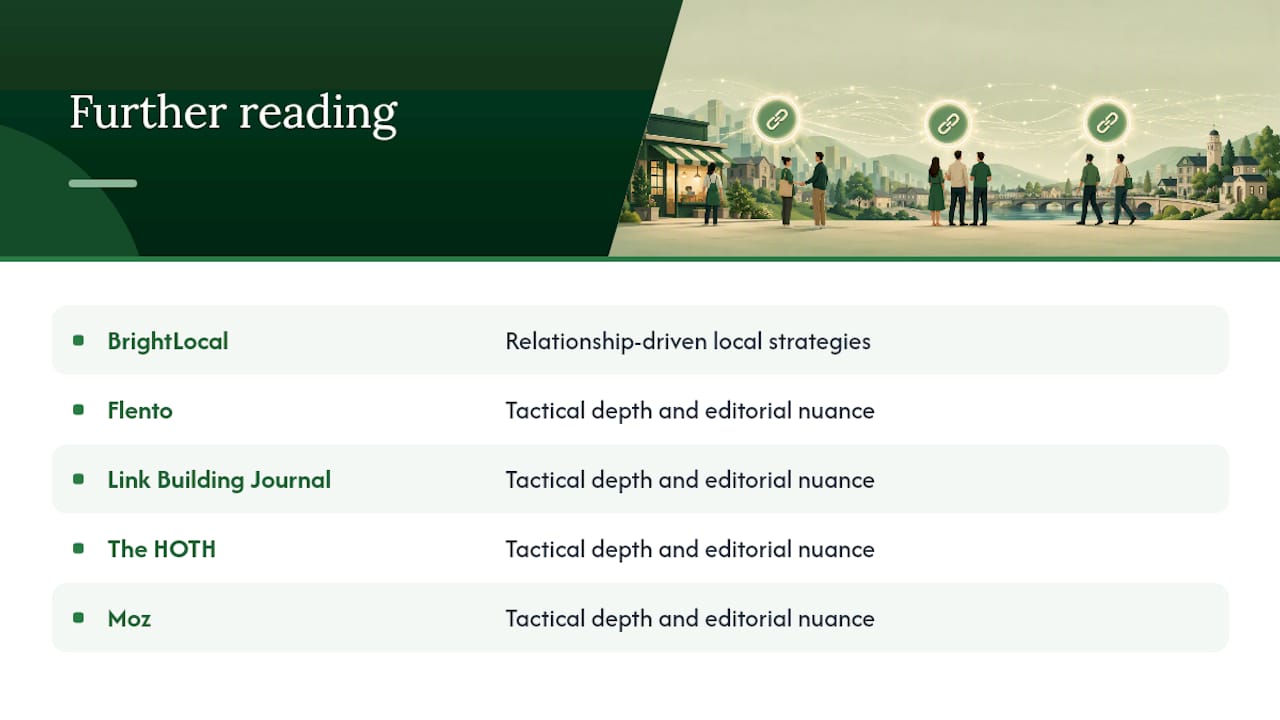
For deeper tactics and data, BrightLocal covers relationship-driven local strategies, while Flento, Link Building Journal, The HOTH, and Moz each add tactical depth and editorial nuance worth reading.
Sources
- Local Link Building: 25 Ways to Get Quality Local Backlinks | Flento
- Local Link Building: How to Dominate Your Local Market (2026 Guide) - Link Building Journal
- Local Link Building For SEO (HOTH)
- Essential Local Link Building Tactics - Moz