
Local citation building means getting your business name, address, and phone number listed consistently across directories, aggregators, and platforms Google trusts. The first move isn't submitting to fifty sites. It's auditing what already exists and locking one canonical NAP format. Do that first, and the rest of this guide gives you an ordered checklist to build 40 to 80 quality citations without creating new conflicts.
TL;DR:
- Consistent NAP formatting across 40 to 80 high-authority directories provides the best local search ranking benefits, with diminishing returns beyond that range.
- Auditing existing listings and fixing incorrect or outdated data before building new citations significantly outperforms bulk submission without cleanup.
- Claiming and verifying core foundation platforms like Google, Bing, Apple, Yelp, and Facebook is crucial since they influence downstream directories and local pack visibility.
- Industry-specific and local directories often carry more relevance and ranking weight than generic sites, especially in competitive markets.
- Regular ongoing monitoring and updates are essential to prevent citation drift, duplicate listings, and incorrect details that can harm rankings over time.
Table of Contents
- Why Does Local Citation Building Matter for Search Visibility?
- Auditing and Locking Your Canonical NAP
- Claiming the Foundation Platforms First
- Seeding Aggregators and Industry Directories
- Finding Where Your Search Competitors Are Listed
- How Do You Verify a Citation Is Actually Indexed?
- What Does Local Citation Building Cost, and When Should You Outsource?
- Setting Up Ongoing Monitoring and Maintenance
- Structured Citations vs. Unstructured Citations
- Prioritizing Citations by Business Type and Market Competition
- Common Pitfalls That Undermine Citation Building
- Tools for Managing and Monitoring Citations at Scale
- Honey Badger SEO's Practitioner View on Managed Citation Building
- Get Your Citations Built and Managed Correctly
- Sources
Why Does Local Citation Building Matter for Search Visibility?
A citation is any online mention of your business's name, address, and phone number, and Google leans on that scattered data to confirm you're a real, locatable business. When directories agree on your details, Google treats your Google Business Profile as more trustworthy, which feeds directly into local-pack placement. When they disagree, even slightly, that trust erodes.
Citations do double duty. They're a ranking signal, and they're also standalone traffic sources. Someone browsing Yelp or a chamber directory can call you straight from that listing, no Google search required.
- Verifies your Google Business Profile and supports local-pack relevance
- Drives direct referral traffic and phone calls independent of rankings
- Inconsistent NAP data across listings actively harms trust and rankings
Consistency matters more than volume here. Research on citation performance shows that consistent NAP across 40 to 80 high-authority, relevant directories typically produces the biggest ranking lift, with returns dropping off sharply past that range. Most new citations get indexed within a few weeks, though data aggregators can take two to three months to fully propagate.
Auditing and Locking Your Canonical NAP
Before you submit anything new, decide exactly how your business name, address, phone number, website URL, and primary category will appear everywhere, forever. Not "close enough." Character for character.
- Write your canonical NAP in a shared document: exact suite number, abbreviation style ("St." vs. "Street"), phone format, and preferred URL structure.
- Search Google, Bing, and major directories for your business name and old phone numbers to surface every existing listing, including duplicates from a previous address or ownership.
- Flag every listing that doesn't match your canonical format, especially old addresses, defunct phone lines, or a second Facebook page nobody remembers creating.
- Gather your supporting assets: a tailored 150 to 300 word description for each platform, hours, logo, photos, and a general contact email.
- Fix the flagged listings before adding a single new one.
That last step is the one people skip. Auditing before building consistently outperforms adding new listings on top of broken data. A generic, keyword-stuffed description copy-pasted across ten sites also underperforms; a description written for each directory's audience tends to pull a better click-through rate.
Pro Tip: Keep your canonical NAP document in a shared spreadsheet from day one. Every future submission, whether you or an agency does it, should copy from that single source, never retype from memory.
Claiming the Foundation Platforms First
Foundation platforms carry the highest immediate impact: Google Business Profile, Bing Places, Apple Business Connect, Yelp, and Facebook. Claim and verify all five before touching a single aggregator or niche directory. These five feed data into countless smaller sites downstream, so errors here multiply everywhere else.
- Google Business Profile: input your exact canonical NAP, select accurate primary and secondary categories, upload real photos, and verify by postcard, phone, or video depending on what Google offers your listing.
- Bing Places: import from Google Business Profile where possible, but double-check the address formatting didn't shift during the import.
- Apple Business Connect: verify ownership through Apple's own confirmation flow; this listing feeds Apple Maps and Siri location results directly.
- Yelp: claim the free listing, add categories and hours, and resist the upsell calls until your other foundation work is done.
- Facebook: confirm your business page's "About" section matches your canonical NAP exactly, including the phone format.
Keep every login in one place. Losing access to a claimed listing because an employee set it up on a personal email is a common, entirely preventable headache.
Seeding Aggregators and Industry Directories
Once your foundation five are locked, move to data aggregators. Services like Data Axle, Neustar/Localeze, Foursquare, and Factual feed your NAP data downstream into dozens of smaller directories automatically, which is far more efficient than chasing each small site by hand.
After aggregators, shift to directories that actually matter for your industry and location. A plumbers' association directory or a state contractors' board listing carries more weight for a plumbing business than another generic business directory ever will.
- Submit to the major aggregators first; let their propagation do the heavy lifting
- Research two to three vertical directories specific to your trade or profession
- Add city or county chamber of commerce and Better Business Bureau listings
- Skip mass-submission services promising hundreds of links overnight; low-quality, spammy directories can do more harm than good
- Follow the order: foundation platforms, then aggregators, then industry and local directories
Industry-specific directories often outperform generic ones for relevance. One well-chosen vertical listing can carry more ranking weight than ten unrelated generic ones.
Finding Where Your Search Competitors Are Listed
Forget the business three doors down that you consider your real-world rival. What matters is who's actually occupying the local-pack spots for your target keywords. Those are your SERP competitors, and they're often not who you'd guess.
- Search your main service keyword plus city name, then note every directory link that surfaces for the top three ranking competitors
- Visit each competitor's Google Business Profile and check their website footer or "find us on" section for directory badges
- Use a citation finder tool or local SEO scanning tool to pull a competitor's known listings in bulk instead of checking one by one
- Prioritize by domain authority first, industry relevance second, and general directory volume last
If three of your top five SERP competitors all show up on the same regional directory, that's a strong signal it's worth your time, even if it's a site you'd never have found searching for "best business directories."
How Do You Verify a Citation Is Actually Indexed?
A submission confirmation email doesn't mean Google has indexed the page. Confirm it separately.
- Run a
site:search combined with your business name to check if the specific directory page is indexed. - Spot-check your Google Business Profile and Google Maps listing a few days after major foundation platform changes to confirm nothing broke.
- Log into aggregator dashboards (where available) to check propagation status rather than guessing.
Foundation platforms usually confirm within days. Aggregator-fed listings often take weeks to two to three months to fully propagate. If a listing still isn't indexed after a reasonable window, resubmit, contact the directory directly, or open a support ticket with the aggregator.
What Does Local Citation Building Cost, and When Should You Outsource?
Per-citation pricing swings wildly. Bulk freelance submissions can run as low as $0.13 each, but they typically skip verification entirely. Premium white-label services can run up to $4.73 per citation. An optimal price range per citation through manual services typically falls within a moderate dollar range and includes quality checks..
- Manual submissions typically take 10 to 20 minutes each once your assets are ready
- A full 40 to 80 citation campaign runs roughly 10 to 25 hours of focused work if done in-house
- Vet any vendor by asking for a sample deliverables list, proof of indexation checks, and shared spreadsheet or login access
- Walk away from any vendor unwilling to hand over login credentials or provide ongoing monitoring after the initial build
Setting Up Ongoing Monitoring and Maintenance
Citations aren't a one-time project. Business details change, directories get scraped by scammy aggregators, and duplicates creep back in.
- Check your foundation platforms and top ten directories quarterly for drift, even if nothing has changed on your end.
- Recheck immediately after any address move, phone number change, or rebrand, don't wait for the quarterly cycle.
- Track every listing in a spreadsheet with columns for URL, login credentials, current status, and last-verified date.
- Re-seed aggregators whenever you catch a data drift, since a stale aggregator record will keep re-infecting downstream directories.
- Merge or request removal of duplicate listings as soon as you spot them.
Pro Tip: Set a recurring calendar reminder for the first week of each quarter. Citation drift is silent. Nobody emails you when Yelp reverts your suite number.
Structured Citations vs. Unstructured Citations
Structured citations live in a predictable format: a directory listing with clearly labeled fields for name, address, phone, category, and hours. Google Business Profile, Yelp, and Bing Places are all structured. The data sits in defined slots, which makes it easy for search engines to parse and cross-reference against your other listings.

Unstructured citations show up differently, mentions of your business embedded in a blog post, a news article, a local event page, or a sponsor list where your NAP appears in running text rather than dedicated fields. A local newspaper writing "Smith's Plumbing, located at 400 Main Street, sponsored the event" counts as an unstructured citation.
Structured citations should dominate your early build because they're easier to control, verify, and audit. You know exactly where the address field is and can fix it directly. Unstructured citations carry real value too, especially for authority and topical relevance, but you can't edit them the same way. You have to ask the publisher for a correction.
The practical approach: front-load structured citations across foundation platforms, aggregators, and directories first, since that's where NAP consistency does its heaviest lifting for local-pack signals. Treat unstructured mentions as a bonus that comes from PR, sponsorships, and community involvement rather than something you build directly. Chasing unstructured citations before your structured foundation is solid is backwards. Fix the controllable data first.
Prioritizing Citations by Business Type and Market Competition
Not every business needs the same citation volume or the same directory mix. A single-location dentist in a mid-size suburb faces different competition than an insulation contractor competing across five counties in a metro area.
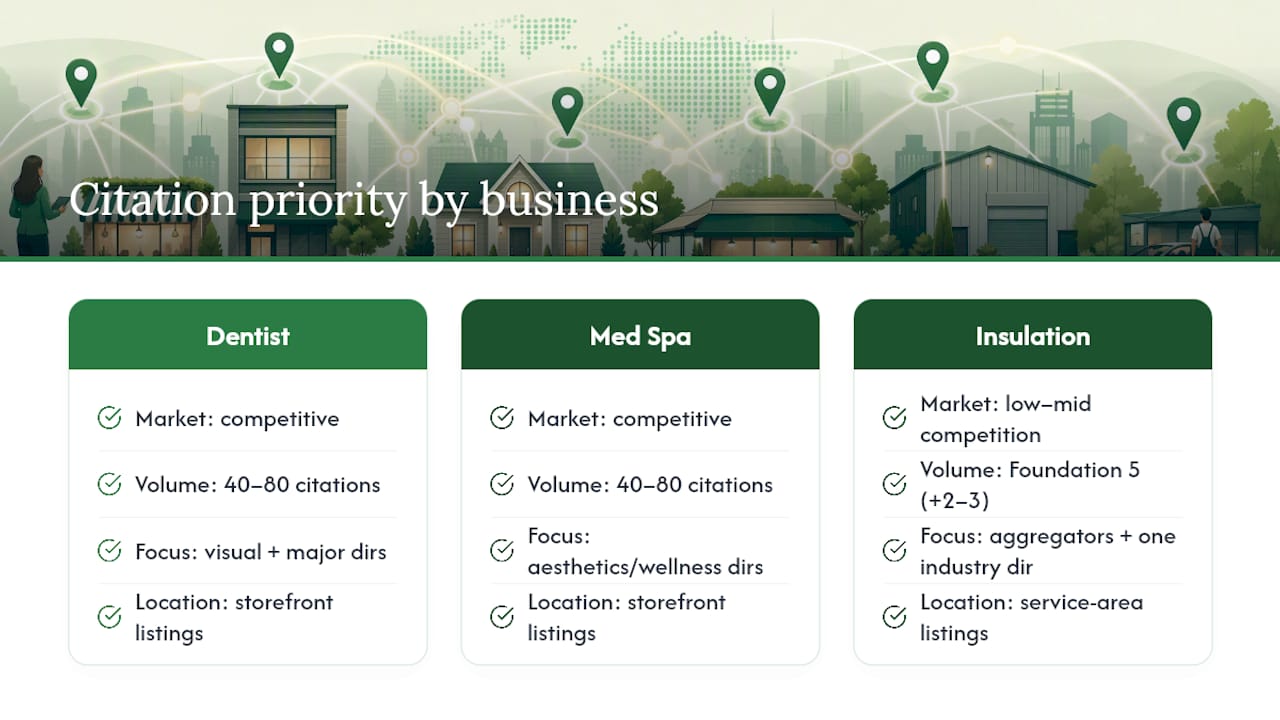
For low-competition markets, a smaller, tighter set of citations, your foundation five plus two or three aggregators and one industry directory, often gets the job done. Chasing 80 citations when you're the only insulation contractor within twenty miles wastes hours you could spend on review generation instead.
For competitive urban or suburban markets, particularly in categories like dental, med spa, or home services where a dozen businesses fight for the same three local-pack spots, the full 40 to 80 citation range matters more, and industry-specific directories carry disproportionate weight. A med spa listed on a dedicated aesthetics or wellness directory picks up relevance signals a generic directory can't match.
Business type changes the directory mix too. Service-area businesses without a storefront (plumbers, insulation installers, mobile detailers) need to be careful about which directories require a physical address versus those that support service-area listings without exposing a home address. Storefront businesses like dental practices or med spas should prioritize visual platforms, Google Business Profile photos, Apple Business Connect, Yelp, where potential patients browse before calling.
The general rule: match your citation intensity to your local-pack competition, not to some fixed number you saw in a guide. A business fighting for position four in a crowded market needs a more aggressive build than one with no local competition at all.
Common Pitfalls That Undermine Citation Building
The single biggest mistake is building on top of bad data. Adding forty new citations with a wrong suite number just multiplies the error forty times over, and now you have forty places to fix instead of one.
Inconsistent formatting trips up businesses that don't realize "Suite 200" and "Ste. 200" read as different addresses to some directory matching algorithms. Small formatting drift across platforms adds up to a trust problem Google can flag even when a human would read both as identical.
Duplicate listings are another recurring headache, especially for businesses that have moved, rebranded, or changed ownership. Old listings under a previous name or address often stay live and indexed, actively competing with your current, correct listing for the same search queries.
Mass-submission services promising hundreds of citations for a flat low fee tend to dump your business into low-quality, sometimes defunct directories that provide zero ranking value and occasionally get flagged as spam. Cheap bulk submissions skip the verification step entirely, so errors go unnoticed until they've already spread.
Finally, treating citation building as a one-time task rather than an ongoing responsibility causes slow, invisible decay. Directories change their data formats, get acquired, or get scraped by newer aggregators pulling from outdated records. Without quarterly checks, a business can drift from consistent to conflicting over eighteen months without anyone noticing until rankings quietly slip.
Tools for Managing and Monitoring Citations at Scale
Manually tracking 40 to 80 citations across a spreadsheet works for a single-location business, but it gets unwieldy fast for multi-location brands or agencies managing several clients. That's where citation management and monitoring tools earn their keep.
Citation finder tools scan the web for existing mentions of your business and flag inconsistencies against your canonical NAP, saving hours of manual searching during the audit phase. Local SEO scanning tools go further, tracking your visibility across multiple directories and alerting you when a listing changes or disappears.
For ongoing monitoring, look for software that checks your top directories on a recurring schedule and flags drift automatically rather than requiring a manual quarterly review every time. Some platforms also handle bulk submission to aggregators directly, cutting down the manual entry time significantly for the initial build.
The tradeoff is real: automated tools speed up discovery and monitoring, but they still require human judgment to verify accuracy and fix errors at the source. A tool that flags a duplicate listing doesn't merge it for you, someone still has to contact the directory or use its claim process.
For a solo business owner handling their own citations, a well-organized spreadsheet plus quarterly manual checks may be all you need. For businesses managing citations across several locations or verticals, dedicated monitoring software (or a managed service that includes it) becomes worth the cost simply to catch drift before it compounds.
Honey Badger SEO's Practitioner View on Managed Citation Building
Every client engagement follows the same order: audit first, lock canonical NAP, claim the foundation five, seed aggregators, then layer in industry directories before moving to quarterly monitoring. Clients get a shared spreadsheet with live login access and monthly reports showing exactly what got submitted and verified.
A DIY approach works fine for a single-location business with time to spare. Once you're managing multiple locations or a competitive market, handing citation management to a dedicated service usually saves more hours than it costs.
— Anas
Get Your Citations Built and Managed Correctly
Seohoneybadger handles local citation building the same way described throughout this guide, audit, canonical NAP lock, foundation platforms, aggregators, industry directories, then ongoing quarterly monitoring, without outsourcing any of it to a third party. You get full ownership of every login and a shared spreadsheet tracking status on every listing, not a black box you have to trust blindly.
Clients working with Seohoneybadger receive Google Business Profile verification and optimization, aggregator and directory submissions, monthly monitoring reports, and direct access to every account created on their behalf. Pricing runs on a transparent, month-to-month basis with no long-term contract locking you in. If you're weighing whether to build citations yourself or hand it off, check out Local SEO Services for a breakdown of what a managed engagement includes, then request a quote to see what a corrected, consistent citation profile could do for your local visibility.
Sources
- Citation Building: Definition, Process and Local SEO (2026) - theStacc
- How to Build Local Citations & Boost Your Visibility Online | WordStream
- What Are Local Citations? Learn Local SEO - Moz