
Most small and mid-sized service businesses should start with an agency, most mid-market companies land best with a hybrid setup, and most enterprises need in-house ownership backed by outside specialists. The reasoning comes down to three things: cost, speed to results, and how fast each model adapts to AI-driven search like AEO and GEO. Agencies win on speed and price for smaller budgets; hybrid wins once you have enough volume to justify a dedicated hire but still need specialized firepower.
TL;DR:
- Agencies are ideal for local businesses with small budgets needing quick results, typically under $3,000 monthly, and a short ramp-up time.
- In-house SEO becomes more cost-effective for larger volumes, especially when engineering access and data sensitivity require dedicated internal resources.
- A hybrid model often suits mid-market companies with a budget between $3,000 and $10,000, combining internal strategy with specialized agency execution for technical and location SEO.
- Hiring an in-house SEO can cost $110,000 to $180,000 in the first year, with a three- to four-month ramp period, whereas agencies typically cost $12,000 to $36,000 annually.
- Effective hybrid teams require clear governance, written ownership of deliverables, and shared roadmaps to prevent coordination breakdowns.
Table of Contents
- In House Vs Agency SEO: Weighing the Real Tradeoffs
- What Does In-House SEO Actually Cost vs an Agency Retainer?
- Which Signals Point to Agency, In-House, or Hybrid?
- How Should a Hybrid SEO Team Actually Be Structured?
- How Do You Vet an In-House Hire or an Agency Before Signing?
- Why Case Studies Matter More Than Credentials
- A Pragmatic Take for Local Service Businesses
- How Honey Badger SEO Fits Whichever Model You Choose
- Sources
- FAQ
In House Vs Agency SEO: Weighing the Real Tradeoffs
The in-house vs agency SEO debate usually gets framed as a loyalty question. It's actually a resource question. Each model solves a different constraint, and the honest answer depends on what you're short on: money, time, or context.
In-house SEO puts a person (or team) inside your company, working alongside product, sales, and engineering every day. That proximity is the whole point. An in-house hire understands why your service pages are worded a certain way, sits in on sales calls, and can push a fix through engineering without three rounds of approval. SEO Sherpa's analysis of the model notes this integration advantage is real, but it comes paired with resource bottlenecks. One person can only run so many audits, write so much content, and chase so many links before something slips.
Agency SEO trades context for breadth. You get a team that has already solved your exact problem for a dozen other clients, plus access to tools most companies would never buy for one person's use. The tradeoff is distance. An agency doesn't sit in your Monday meetings and won't always catch a nuance about your service area or your customer's buying triggers unless you feed it to them deliberately.
In-house strengths:
- Deep brand and product context that improves content and messaging accuracy
- Faster internal decisions since no client approval layer exists
- Institutional memory that compounds over years, not months
In-house limits:
- High fixed cost regardless of output that month
- Narrow skill coverage. One hire rarely covers technical SEO, content, and link building equally well
- Slow ramp time before the hire produces consistent results
Agency strengths:
- Immediate access to a full team: technical, content, link building, and increasingly AEO/GEO specialists
- Faster execution windows because the tooling and processes already exist
- Exposure to patterns across many clients, which sharpens what actually moves rankings
Agency limits:
- Less day-to-day familiarity with your product and customers unless onboarding is thorough
- Communication happens through an account layer, which can slow urgent fixes
- Quality varies significantly by provider, so vetting matters more than with a direct hire
What Does In-House SEO Actually Cost vs an Agency Retainer?
The math here is not close, and that's the part most comparisons undersell. A fully loaded in-house SEO hire, once you count salary, benefits, and the tools they need to do the job, typically runs $110,000 to $180,000 in the first year. A comparable agency engagement usually falls between $12,000 and $36,000 annually.
That gap isn't just about salary. It's about what a single hire can realistically cover. One in-house SEO specialist can't also be a technical auditor, a link builder, a content strategist, and an AEO expert, so the true cost of matching an agency's breadth in-house often means hiring two or three people, not one.
The math at a glance: Agency retainers run roughly $1,000 to $3,000 per month. A single fully loaded in-house hire runs $110,000 to $180,000 in year one, according to ConversionCrush's cost breakdown.
Time to value tells a similar story. Most in-house hires need three to four months just to ramp up before they're producing consistent output, according to the same ConversionCrush analysis. An agency, by contrast, can often start technical audits and initial strategy work within a few weeks because the onboarding process is a known quantity they've run dozens of times.
That ramp period is where opportunity cost hides. Every month spent onboarding a new hire is a month competitors keep publishing content and building links. For a local business trying to rank for a handful of high-value service terms, three or four lost months can mean a full season of missed calls.
- Agency retainer: roughly $1,000 to $3,000 per month, working within a few weeks
- In-house hire: $110,000 to $180,000 in year one, working consistently after 3 to 4 months
- Hybrid budget: often a mid-level in-house hire plus a smaller agency retainer for technical or AEO work
Pro Tip: Budget for the ramp period explicitly. If you're hiring in-house, plan on a near-zero return for the first quarter and build that into your forecast instead of treating it as a surprise.
Which Signals Point to Agency, In-House, or Hybrid?
A gut-feeling decision is how most companies end up with the wrong model for two years before switching. A scored readiness matrix turns this into something closer to a scoring exercise, which several industry frameworks recommend for exactly this reason, including WorksBuddy's decision framework and SingleGrain's 10-factor matrix.
Score each dimension from 1 (favors agency) to 5 (favors in-house), then average:
- Monthly SEO budget available. Under $3,000 scores low; over $10,000 scores high.
- Content volume needed. Occasional blog posts score low; daily publishing across service lines scores high.
- Engineering bandwidth. No dev access on demand scores low; direct pull requests score high.
- Speed-to-impact requirement. Need results in weeks scores low (agencies mobilize faster); a 12-month runway scores high.
- Data sensitivity. Standard marketing data scores low; regulated or highly proprietary systems score high.
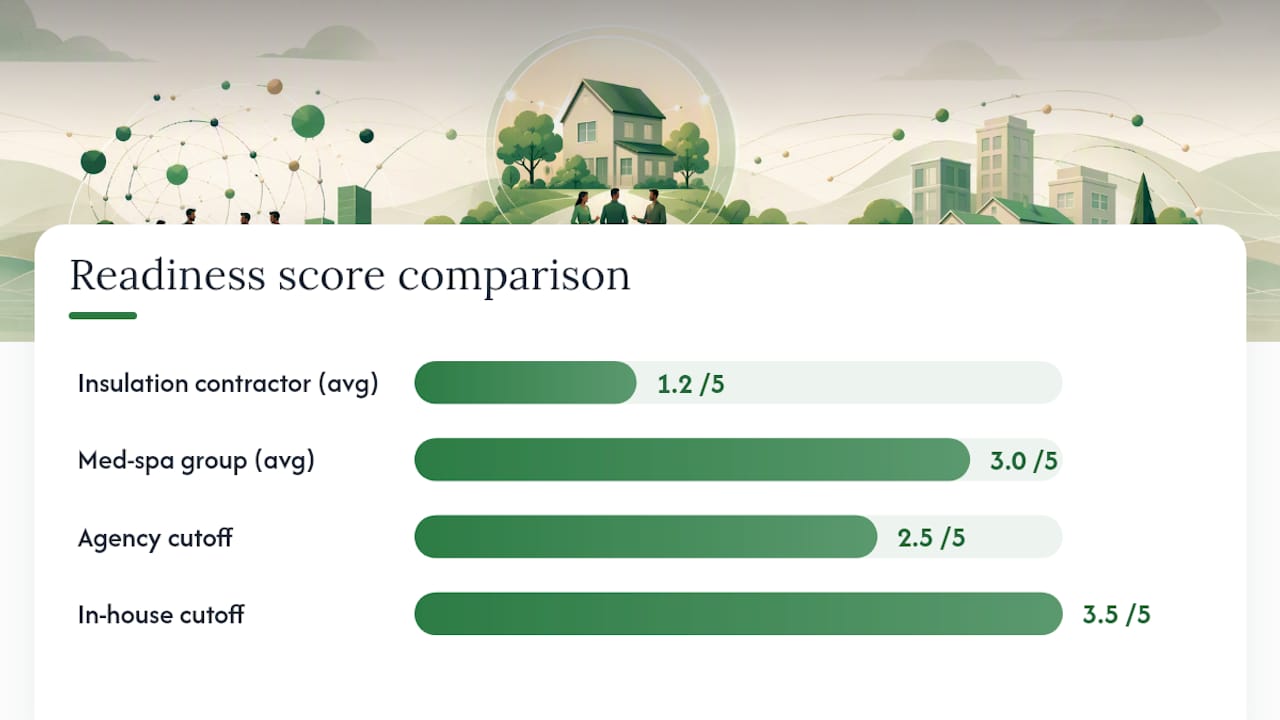
Average under 2.5 points toward an agency. A score between 2.5 and 3.5 usually points to hybrid. Above 3.5, in-house ownership makes sense, especially when engineering access and data sensitivity both score high.
Example: SMB insulation contractor. Budget scores 1, content volume scores 2, engineering bandwidth scores 1, speed-to-impact scores 1, data sensitivity scores 1. Average: 1.2. Clear agency fit.
Example: Mid-market med spa group with 12 locations. Budget scores 4, content volume scores 4, engineering bandwidth scores 2, speed-to-impact scores 3, data sensitivity scores 2. Average: 3.0. Squarely hybrid territory, likely a marketing coordinator in-house paired with an agency for technical SEO and location page architecture.
How Should a Hybrid SEO Team Actually Be Structured?
The split that works most often: keep strategy, brand voice, and stakeholder relationships in-house, and hand technical sprints, link acquisition, and AEO/GEO optimization to an agency. This isn't a compromise position, it's usually the most cost-efficient structure once a company outgrows a pure agency retainer but isn't ready to build a five-person internal team, a pattern multiple case studies back up in SingleGrain's matrix analysis.
Governance is what separates a hybrid model that works from one that quietly falls apart. Without it, both sides assume the other owns a task and nothing ships.
- Define who owns each deliverable in writing, not verbally in a kickoff call
- Set a shared roadmap with monthly checkpoints, not quarterly ones
- Require the agency to document technical changes so your in-house team isn't blind to what shipped
- Build a simple SLA around response time for urgent fixes, like a broken redirect or a tracking issue
The most common pitfall is treating the agency as a vendor instead of a team member. When handoffs happen through email chains with no shared roadmap, work duplicates or drops. A hybrid setup combining an in-house content coordinator plus an agency retainer for technical and link work often lands cheaper than one senior in-house SEO generalist, while covering more ground.
How Do You Vet an In-House Hire or an Agency Before Signing?
The questions you ask in an interview or a proposal review matter more than the answers you get in the first pitch, because everyone sounds capable in a first pitch.
For an in-house candidate, ask:
- Walk me through an AEO or GEO project you've worked on and what changed in traffic
- What's your process for getting a technical fix through an engineering backlog
- How do you tie SEO output to revenue, not just rankings
For an agency proposal, ask:
- Who specifically will work on our account, and what's their tenure at the agency
- What tools do you use for AEO/GEO tracking, and can we see a sample report
- What happens to our assets, content, backlinks, tracking setup, if we leave
Contract essentials for either path:
- Clear asset ownership. You should own your content, your GBP listing, and your tracking data outright.
- A documented knowledge-transfer process if the relationship ends.
- A defined onboarding timeline with specific deliverables by week, not vague milestones.
- SLAs on response time and reporting cadence.
Red flags include vague answers about AEO/GEO work, no mention of measurement tied to leads or revenue, and agencies that won't name who's actually doing the work. Ahrefs' guide to in-house SEO makes a similar point from the hiring side: candidates who can't connect their work to revenue logic tend to underperform regardless of how strong their technical résumé looks.
Why Case Studies Matter More Than Credentials
Anas built Seohoneybadger's approach on a mix of backgrounds that don't usually overlap: professional sports, tech work at Google Waymo, and law enforcement training. This combination shows up as a bias toward composure under pressure and adaptability when Google changes the rules again, which it does often.
The Insulation SEO case study is a useful proof point for local service businesses specifically. It shows what focused local optimization, GBP management, and service-page architecture can do for a category where most competitors barely touch their online presence. That's the same operating model behind the hybrid recommendation above: strategy and relationship ownership close to the client, specialized execution handled by people who do this work daily.
A Pragmatic Take for Local Service Businesses
If you run a dental practice, a med spa, or a home services company, skip the debate about which model is more prestigious and focus on which one gets the phone ringing faster. For most businesses in this category, that's agency-first, specifically because the ramp time on an in-house hire eats a full quarter you don't have to spare.
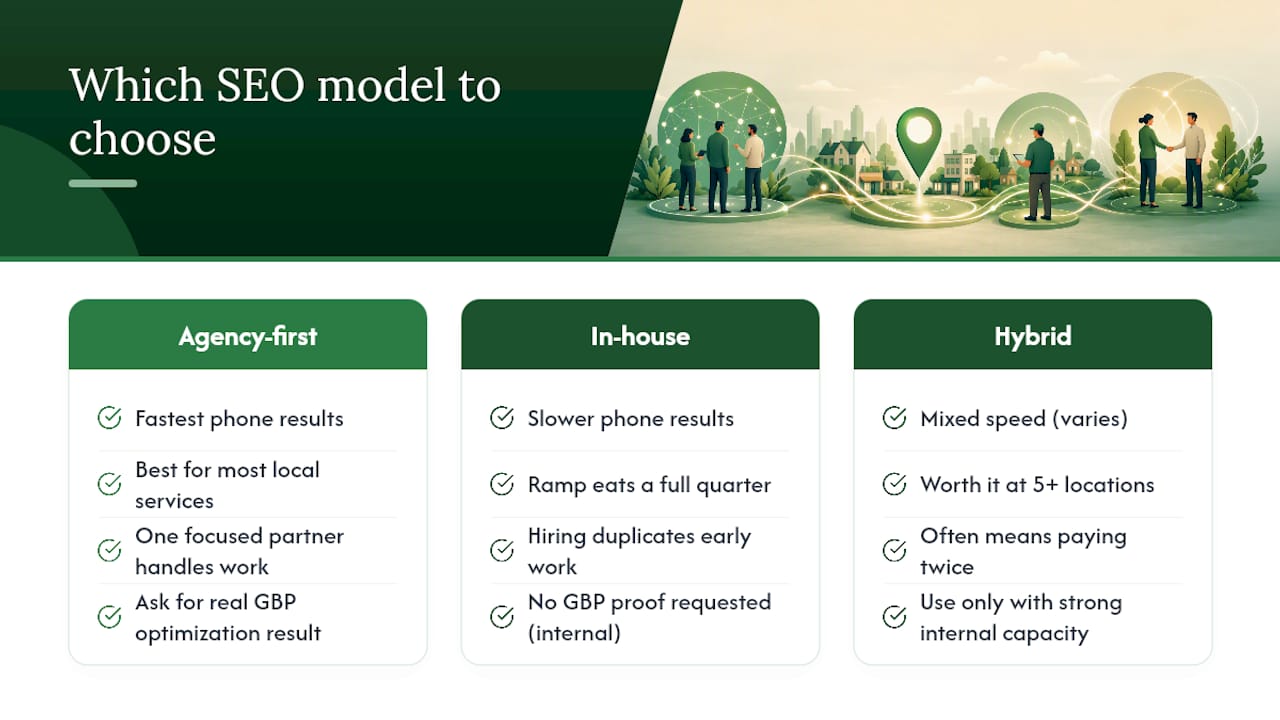
Hybrid becomes worth considering once you're managing five or more locations or you've built enough internal marketing capacity to own content and strategy directly. Below that threshold, hybrid usually just means paying twice for work one focused partner could handle.
Pro Tip: Ask any agency you're evaluating to show you a real GBP optimization result from a business in a similar category to yours. If they can't produce one, that tells you more than their pitch deck does.
**
How Honey Badger SEO Fits Whichever Model You Choose
Whatever your readiness score says, this agency is built for the agency-first and hybrid-execution slots most local service businesses actually need. The difference from a traditional agency: no long-term contract, month-to-month pricing, and every asset, your content, your GBP profile, your tracking, stays yours from day one.
That matters because the biggest risk in the agency model is losing your data and momentum if you leave. Seohoneybadger avoids that by design, whether you need full-service local SEO, hands-on Google Business Profile management, or a website built to rank and convert instead of just look good.
Run the quick fit check: if your business serves a local area, competes on Google Maps visibility, and needs results measured in calls and booked appointments rather than brand awareness, you're squarely in the profile Seohoneybadger works with daily. If you're a dental practice specifically, the dental SEO page walks through what that looks like in practice. The next step is simple: reach out for a direct look at your current Google visibility and what a month-to-month engagement would realistically cost against the ramp time of hiring in-house.
Sources
- SEO Agency vs In-House SEO: Which Is Better for Your Business? (2026) | ConversionCrush Blogs
- In-House vs Agency: Why Even Internal SEO Teams Need Outside Expertise
- In-House SEO vs. Agency: A Decision Framework for IT Teams | WorksBuddy
FAQ
Is Agency or In-House SEO Better?
Neither wins universally. Agencies typically win on cost and speed for smaller budgets, while in-house ownership works better once a company has the volume and engineering access to justify a dedicated team.
Should I Hire an SEO Agency or Do It Myself?
If you lack dedicated marketing staff or technical SEO experience, an agency delivers a full specialist team faster than building one internally, often within a few weeks versus the three to four months it takes to ramp up a new hire.
What's the Difference Between In-House and Agency Marketing?
In-house marketing sits inside your company with daily access to product and sales context, while agency marketing operates externally with broader tool access and cross-client experience but less day-to-day familiarity with your business.
When Does a Hybrid SEO Model Make Sense?
Hybrid fits companies scoring in the middle range on a readiness matrix, typically mid-market businesses with enough budget and content volume to justify an in-house strategist paired with an agency for technical work and AI search optimization.
Does Seohoneybadger Work as an Agency or a Hybrid Partner?
Seohoneybadger operates as a direct, hands-on agency partner for local service businesses, handling SEO, websites, and Google Business Profile management without outsourcing any part of the work.