
Complete your Google Business Profile, build a review system that runs itself, and publish real service and city pages instead of templated ones. That combination moves the map pack fastest. Map pack position often shifts within 30 to 90 days of GBP and citation cleanup, while organic content gains from new pages typically take three to six months to produce steady lead volume. Fix the fast stuff first, then build the slow stuff on top of it.
TL;DR:
- Completing and optimizing your Google Business Profile within the first 30 days can significantly improve your map pack visibility in 30 to 90 days.
- Building dedicated city and service pages, along with local schema markup, typically takes three to six months to generate consistent lead volume.
- Collecting 8 to 15 real, recent reviews monthly at the moment of service increases rankings and conversions, especially when reviews mention specific services and locations.
- Maintaining consistent NAP citations and acquiring local backlinks from suppliers, community groups, and local press enhances your prominence and credibility over time.
- Prioritizing fast GBP and review work before investing in backlinks or additional pages ensures foundational assets are strong, preventing wasted effort on ineffective strategies.
Table of Contents
- What Is Home Service SEO and Why Does It Work Differently?
- What Should You Fix First in the First 90 Days?
- How Do You Optimize Google Business Profile for a Home Service Business?
- How Should You Structure Service Pages and City Pages?
- How Do You Build a Review System That Actually Works?
- How Do You Keep Citations Consistent and Build Local Links?
- What Technical SEO Basics Matter Most for Contractor Sites?
- How Do You Create Content That Gets Cited by AI and Google?
- What Should You Actually Track Every Month?
- What I've Learned Running Local SEO for Contractors
- How Honey Badger SEO Runs This Playbook for You
- Where to Go Deeper on Local SEO for Contractors
- Sources
What Is Home Service SEO and Why Does It Work Differently?
Home service SEO is the practice of ranking a local trade business (plumbing, HVAC, roofing, insulation, electrical) in Google's map pack and organic results for the services it performs in the areas it serves. It's a subset of local SEO for contractors, but it behaves differently than local SEO for a retail storefront or restaurant because most home service businesses are service-area businesses. There's often no walk-in location, the "storefront" is a truck, and the customer journey starts with a problem (a leaking pipe, a dead furnace) rather than a browse.
Google ranks local results using three factors: relevance, distance, and prominence. Contractors can't move where they're physically located, but they can directly influence relevance and prominence through a complete Business Profile, strong service and location pages, and a steady flow of recent reviews. That's the entire game. Distance is fixed. Relevance and prominence are earned, which is good news, because it means the owner who works the system consistently beats the competitor who has been "in business longer" but never touched their listing.
The rest of this guide is built around a 30/60/90 day framework because that's how the actual timeline works: some fixes move rankings in weeks, others take a full sales season to show up in call volume.
What Should You Fix First in the First 90 Days?
Most owners try to do everything at once and finish nothing. A better approach: triage the fast wins, then layer in the slower structural work.
Days 1 to 30: triage.
- Audit and complete every field on your Google Business Profile, including services, attributes, and business description.
- Make your phone number visible and clickable on every page of your website, not just the contact page.
- Start asking for a review at the moment of job handover, every single job, no exceptions.
- Fix your top one to three site pages: usually the homepage and your two highest-traffic service pages.
Days 30 to 60: build. 5. Build dedicated city pages for your top three to five service areas. 6. Add FAQ schema and LocalBusiness schema to your service pages. 7. Collect and upload real project photos, geo-tagged where possible. 8. Run a full citation cleanup across the directories where your business is listed.
Days 60 to 90 and ongoing: compound. 9. Publish GEO-ready content: cost guides, process explainers, and answer-first FAQs. 10. Start local link outreach with suppliers, vendors, and community organizations. 11. Automate review requests via SMS or email so the ask never depends on a technician remembering. 12. Review your numbers monthly and adjust.
Set targets you can actually measure: aim for 8 to 12 new reviews per month once your ask system is running, and track whether GBP-driven calls increase month over month once your profile is complete.
Pro Tip: Do the GBP and review work before you spend a dollar on new pages or backlinks. A perfectly built city page attached to a half-finished, review-starved profile is like putting a new roof on a house with no foundation.
How Do You Optimize Google Business Profile for a Home Service Business?
Your Google Business Profile carries more ranking weight than almost anything else you'll touch. A fully optimized profile is the single biggest lever for map pack visibility, and it's also the one asset most contractors half finish and never revisit.
Start with categories. Pick the most specific primary category available, "Insulation Contractor" instead of "Contractor," "Emergency Plumber" instead of "Plumber," if that's genuinely your core work. Add two or three secondary categories that reflect real services you offer, but don't pile on ten categories hoping to rank for everything. Google penalizes profiles that look like they're gaming the system, and homeowners are put off by a listing that claims to do everything under the sun.
From there, work through the profile piece by piece:
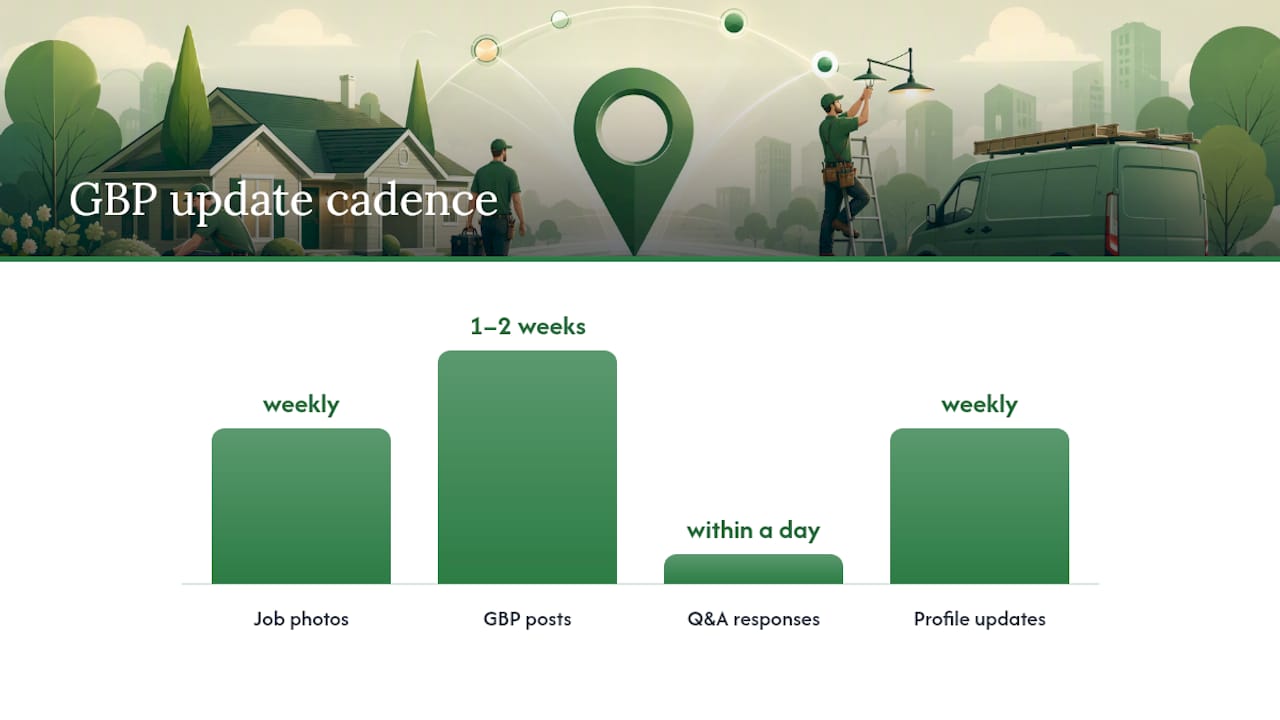
- Services list: Add every service you actually perform, each with a short description written the way a homeowner would search for it ("attic insulation removal" ranks better in the reader's mind than "insulation services, comprehensive").
- Photos: Upload real job photos weekly, not stock images. Before/after shots of insulation jobs, roof replacements, or panel upgrades do double duty as trust signals and fresh content.
- Posts: Publish a GBP post every one to two weeks featuring a completed job, a seasonal offer, or a local tip.
- Q&A: Seed your own frequently asked questions before customers do, and answer any that come in within a day.
- Attributes: Fill in every applicable attribute (women-led, veteran-owned, free estimates, financing available) since these show up as filters homeowners actually use.
- Service areas: List the cities and zip codes you genuinely serve, and be honest about it. Listing 40 miles of radius you rarely drive to hurts relevance more than it helps reach.
If you operate as a true service-area business with no public-facing storefront, hide your address in your profile settings rather than showing a home address or an unmarked warehouse. Google supports this setting specifically for trades that work at the customer's location.
Finally, use your profile as a conversion tool, not just a directory listing. Every post, every Q&A answer, every service description is a chance to work in a local keyword naturally ("furnace repair in [city]") and point toward a click-to-call button or a request-a-quote action. Treat the profile as an active channel you update weekly, not a form you filled out once and forgot.
How Should You Structure Service Pages and City Pages?
The rule that trips up more contractors than any other: one service equals one page. If you offer insulation removal, blown-in insulation, and spray foam, each one deserves its own page with its own title tag, its own H1, and content that matches exactly what a homeowner searching that specific service wants to know. A single "Insulation Services" page trying to cover all three will rank for none of them particularly well.
Each service page needs to include:
- A clear statement of scope: what's included, what's not, and who the service is for.
- A plain-language explanation of your process, step by step.
- Realistic cost ranges, even broad ones, since homeowners search with budget in mind and pages without pricing signals lose that traffic to competitors who provide it.
- A short FAQ section addressing the three or four questions you hear on every sales call.
- Local, real photos from jobs in that category, not generic stock imagery.
- A clear call to action, repeated near the top and bottom of the page.
City pages follow a similar logic but get abused more often. Copying your homepage, swapping in a city name, and calling it a location page doesn't work. City pages with unique local content are a real ranking signal; thin, templated versions can actively hurt you because Google treats them as duplicate or low-value content. A real city page mentions actual neighborhoods you've worked in, references local building codes or climate factors relevant to your trade, and shows project photos from jobs in that specific area.
Interlink deliberately. City pages should link to the specific service pages relevant to that location, and service pages should link back to your top city pages, creating a clean flow that walks a visitor from "I need insulation in Mesa" to "here's exactly what that costs and how it works" to your contact form. Add LocalBusiness schema to your homepage and location pages, and FAQ schema to any page with a question-and-answer section, since both help search engines and AI tools understand and surface your content accurately.
How Do You Build a Review System That Actually Works?
Reviews influence both ranking and conversion, but only if you treat review generation as a system rather than an occasional favor you ask happy customers for.
Timing matters more than most owners realize. Ask at the moment of job handover, in person, while the customer is standing in front of a finished job and feeling good about it. Follow up within a day or two with a short text or email containing a single direct link to your review page. Do not send a long email explaining how reviews work. Send one line and one link.
- At handover: "We'd love a quick Google review if you have two minutes. I'll text you the link." This sets the expectation before you ever leave the driveway.
- Follow-up SMS or email (24 to 48 hours later): A short, friendly nudge with the direct review link, nothing else attached.
- Reply to every review within a few days, thanking positive reviewers by name and referencing the specific job when you can ("Glad we could get that attic insulation done before the cold hit").
- For negative reviews, reply calmly, acknowledge the issue without arguing, and offer to make it right offline. Never get defensive in a public reply.
Encourage detail without scripting it. A review that says "Great insulation job in [neighborhood], showed up on time and cleaned up after" carries more ranking and conversion weight than "Good service, would recommend." You can nudge this gently by asking, "Would you mind mentioning what we worked on?" when you make the ask.
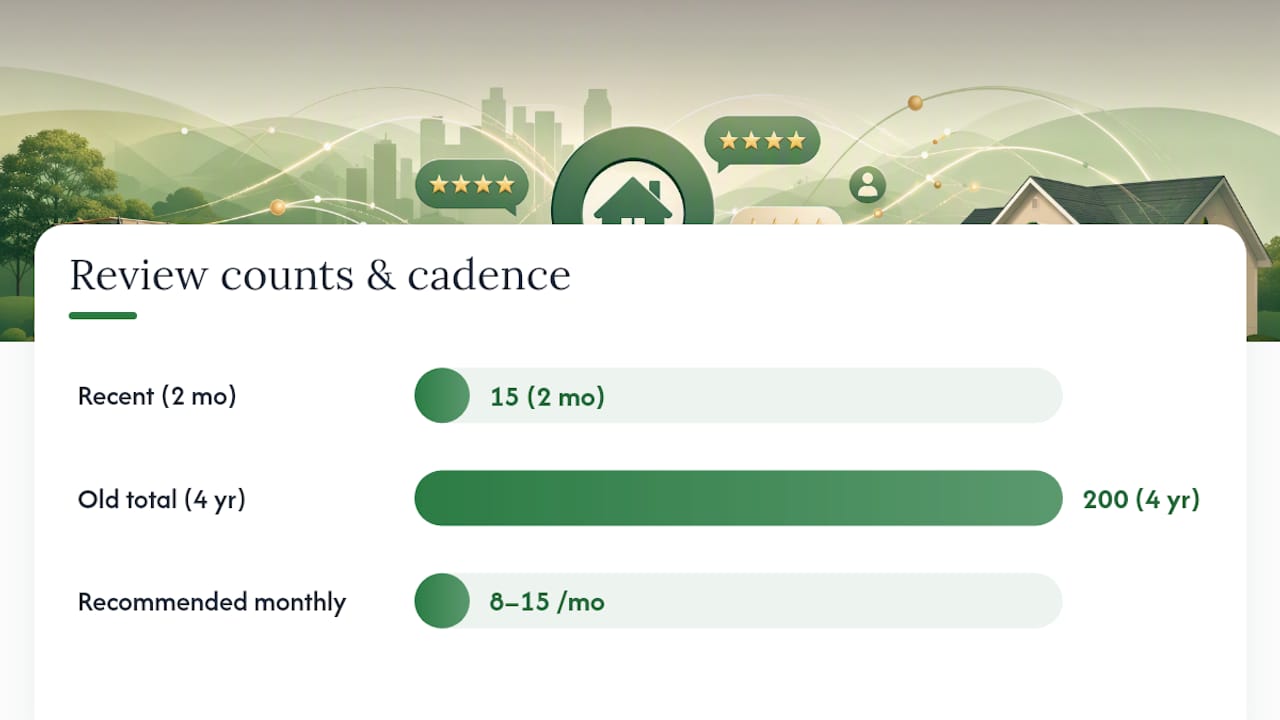
Recency and specificity often outrank raw lifetime totals. A business with 15 reviews from the last two months, each mentioning a real service and city, can outperform a competitor sitting on 200 reviews from four years ago. Aim for a steady monthly cadence, 8 to 15 new reviews a month for most trades, rather than a burst-and-drought pattern.
Pro Tip: If your close rate on review asks is low, the problem is almost never the customer. It's usually that the ask happens too late, days after the job, when the good feeling has faded and the text gets buried.
How Do You Keep Citations Consistent and Build Local Links?
Start by auditing your business name, address, and phone number (NAP) across every directory where you're listed: Google, Bing, Apple Maps, Yelp, Angi, and any trade-specific directories in your industry. Mismatches, an old suite number, a phone number you retired two years ago, a business name that reads "Smith Plumbing LLC" in one place and "Smith Plumbing Inc." in another, quietly erode the prominence signal Google uses to rank you.
- Pull a current list of every citation you can find using a manual search or a citation-tracking tool, then correct every discrepancy at the source.
- Prioritize the big general directories first (Google, Bing, Apple, Yelp, BBB), then move to trade-specific ones (HomeAdvisor, Angi, Porch, or your state contractor licensing board listing).
- Quality beats quantity here. A handful of accurate, high-authority citations does more for prominence than fifty listings on directories nobody visits.
- For local links, look at suppliers and manufacturers you buy from, most maintain a "find a contractor" or dealer locator page that will link to you for free if you ask.
- Sponsor a local youth sports team, a community event, or a trade school scholarship. These generate genuine local links and goodwill at the same time.
- Reach out to local news outlets or neighborhood blogs when you complete a notable project, a storm-damage repair rush, a historic home renovation, since local press links carry real weight.
If you're a single-location owner with time to spare, manual citation fixes are doable in a weekend. If you operate across multiple cities or have years of inconsistent listings to untangle, a citation management service or an SEO partner who handles it directly usually pays for itself in the hours it saves.
What Technical SEO Basics Matter Most for Contractor Sites?
Technical problems don't always show up as an obvious ranking drop. Sometimes they just quietly cap how high you can climb, which is worse, because you never know what you're missing.
Mobile performance comes first. Most homeowners searching "emergency plumber near me" are on a phone, often in a moment of stress, and a slow-loading, image-heavy job page will lose them before it finishes rendering. Run your top pages through Google's PageSpeed Insights and fix anything flagged under Core Web Vitals, particularly load time and layout stability on pages with a lot of before/after photos.
- Add LocalBusiness schema site-wide, and layer in the specific trade schema type where available (Plumber, RoofingContractor, HVACBusiness) so search engines understand exactly what kind of business you are.
- Add FAQ schema to any page with a question-and-answer section, which also feeds AI answer engines looking for structured, quotable content.
- Submit a clean XML sitemap and make sure every service and city page is included, not just your homepage.
- Set canonical tags correctly, especially if you have similar pages for nearby cities, to avoid Google treating them as duplicates.
- Structure URLs logically:
/services/insulation-removal/and/locations/mesa-az/reads far cleaner to both users and crawlers than a jumble of query strings. - Compress and serve responsive images for your before/after photo galleries, since full-resolution camera photos are one of the most common site-speed killers on contractor websites.
Pro Tip: Before/after photos sell the job, but an unoptimized 8MB image can undo everything else you fixed on the page. Compress every photo before it goes live, no exceptions.
How Do You Create Content That Gets Cited by AI and Google?
The content that works best for home service businesses in 2026 does two jobs at once: it answers a homeowner's question directly, and it gives AI answer engines something concrete and sourced enough to cite. That's the core idea behind Generative Engine Optimization, or GEO, which complements traditional local SEO rather than replacing it.
Structure every piece answer-first: state the direct answer to the question in the first sentence or two, then follow with the supporting detail, local specifics, and nuance. A page titled "How Much Does Attic Insulation Cost in Phoenix?" should answer that question in the opening lines with a real range, not bury it under three paragraphs of company history.
- Cost guides: Homeowners search cost questions constantly, and a page with honest, specific ranges (even "$1,800 to $3,200 depending on attic size and R-value") outperforms vague pricing language every time.
- Process explainers: Walk through exactly what happens on a typical job, step by step, which builds trust before the first call even happens.
- FAQ hubs: Compile the questions you actually get asked on sales calls into one well-organized page, marked up with FAQ schema.
Sourced figures and named local details raise the odds an AI system will cite your page instead of a competitor's. A page that names the exact neighborhood, references a real local code requirement, or cites a specific cost range reads as more trustworthy to both homeowners and AI crawlers than generic, interchangeable copy. GEO-focused content that combines local specificity with sourced figures tends to serve both goals at once, ranking well in traditional search while also getting pulled into AI-generated answers.
Don't overlook the content you already have sitting in your review inbox. Pull specific, well-written customer language from your reviews and GBP posts and weave it, credited and unedited, into FAQ sections or process pages. It's free, authentic material that homeowners already trust.
What Should You Actually Track Every Month?
Measurement doesn't need to be complicated, but it does need to happen consistently, or you'll never know which of the changes above actually moved the needle.
Track these numbers monthly at minimum:
- GBP Insights: profile views, split between discovery searches (someone found you searching a service) and direct searches (someone searched your business name).
- Call volume from GBP: the click-to-call button and any calls attributed directly to your profile.
- Website form submissions: requests for quotes or estimates coming through your contact forms.
- Rank position across service areas: run a grid or radar-style rank check across your top three to five cities rather than relying on a single rank number, since map pack position varies by exact location searched.
Set up call tracking with dynamic number insertion, using a service like CallRail, so you can tell which calls came from organic search, which came from a paid campaign, and which came from your GBP listing specifically. Without that split, you're guessing at what's actually working.
Report on a monthly cadence, and calibrate your expectations to the timeline: citation and GBP fixes tend to show up in map pack movement within 30 to 90 days, while new service and city pages usually need three to six months of indexing and authority building before they produce a steady, reliable stream of calls. If nothing has moved by month four, that's the point to audit what's actually been done, not to assume local SEO doesn't work for your trade.
What I've Learned Running Local SEO for Contractors
The biggest trade-off every home service owner faces isn't in-house versus agency. It's speed versus permanence. GBP work moves fast and matters immediately, but it's also rented land, Google can change the rules on categories or attributes overnight. Owned content, real service and city pages, a review library full of specific customer language, holds its value regardless of what Google tweaks next quarter. The smartest sequence prioritizes GBP first because it's fast, then builds the permanent assets on top of that early momentum.
The mistakes repeat across almost every campaign we've seen. Thin, templated city pages that swap out a city name and nothing else. Review strategies that exist on paper but depend on a busy technician remembering to ask, which means they quietly stop happening within a month. NAP inconsistency that nobody notices until a citation audit surfaces fifteen different versions of the same business name.
The insulation contractor work we've done is a decent example of this playbook running in sequence rather than all at once: GBP and reviews first, real city and service pages second, technical cleanup and GEO content layered in as the foundation held. There's no shortcut that skips the order. The businesses that try to jump straight to backlinks and blog content, without a finished profile or a working review system underneath it, end up building on sand.
— Anas
How Honey Badger SEO Runs This Playbook for You
Seohoneybadger runs this exact 30/60/90 sequence for contractors instead of leaving it to a part-time marketing hire or a set-it-and-forget-it agency retainer. The difference shows up in the details most vendors skip: GBP is managed weekly, not touched once at onboarding, and every service and city page is written from real project details, not swapped-out templates.
The engagement runs month-to-month, with no long-term contract locking you in, and you keep ownership of every asset built, your website, your content, your GBP listing, all of it. Services cover full Google Business Profile management, service and city page builds, a review system that actually runs on autopilot, and call tracking so you can see exactly which calls came from which channel. Everything gets handled directly, with no outsourcing to a third party you'll never talk to.
If you want a straight look at where your profile, pages, and citations currently stand, request a free audit through Seohoneybadger's local SEO services page, and if you're running an insulation, HVAC, roofing, or similar trade business in a competitive market, start there and see exactly what's missing before you spend another dollar on ads.
Where to Go Deeper on Local SEO for Contractors
A few resources worth bookmarking alongside this guide:
- Google Business Profile Help remains the definitive source for category options, attribute settings, and policy updates that affect ranking eligibility.
- The SEO Brothers guide to home services SEO goes deep on service-area page architecture and citation strategy.
- BKND Development's contractor SEO guide breaks down GBP's outsized role in map pack ranking.
- The GEO guide from Theadexperts is useful for understanding how AI answer engines are starting to source contractor content.
Sources
- Local SEO for Contractors: Rank Higher and Book More Jobs
- Local SEO for Contractors: The Complete 2026 Guide | SEO Insights | BKND Development
- Home Services SEO & GEO Guide for 2026 - Theadexperts
- SEO for Home Services Businesses: Local Search for Service-Area Trades | SEO Brothers