
Dental SEO means making your practice the obvious local answer when someone searches for a dentist, an implant, or emergency care near them. The highest-leverage moves include fixing your Google Business Profile, building procedure-specific service pages, and removing friction from your booking flow. Most practices see meaningful movement in 30 to 60 days, with full breakeven around 6 to 9 months.
TL;DR:
- Improving Google Business Profile requires filling out all fields, optimizing categories, and gaining recent reviews for higher Local Pack rankings.
- Most service pages should focus on targeting specific keywords with detailed content about procedures, costs, and booking calls, linking to related pages.
- Site speed, mobile booking ease, and schema implementation are critical, with visible phone numbers and fast load times influencing conversions within 30 to 60 days.
- Consistent review velocity and citation audits significantly impact local rankings, and responses to reviews should be prompt to build trust and authority.
- Achieving SEO breakeven typically takes six to nine months, with early gains from foundational work like GBP and citations, and long-term ROI depends on call tracking and booked patient attribution.
Table of Contents
- How Do You Optimize Google Business Profile for a Dental Practice?
- What Service Pages Should a Dentist Website Have?
- Why Does Site Speed and Mobile Booking Affect Dental SEO?
- How Do You Manage Reviews and Local Citations for a Dental Office?
- How Do You Track SEO Results and ROI for a Dental Practice?
- What Should a Dentist Do First: A 90-Day SEO Checklist
- Does Dental-Specific SEO Actually Outperform Generic Local SEO?
- Should You DIY Dental SEO or Hire a Specialist?
- Honey Badger SEO: Hands-On Help for Dental Practices
- Sources
How Do You Optimize Google Business Profile for a Dental Practice?
Google Business Profile carries a significant portion of the ranking weight behind Local Pack placement, which makes it the single fastest lever you have. Reviews and citation consistency round out the rest, but GBP signals do the heaviest lifting for dental queries specifically.
Start with the primary category. "Dentist" is fine, but if you specialize, a more precise category like "Cosmetic dentist" or "Pediatric dentist" often outperforms the generic label for relevant searches. From there, work through the profile methodically:
- Fill every field GBP offers, including attributes, service areas, and business hours (holiday hours included).
- List every procedure you offer as a distinct service line, with a 200 to 300 character description that mentions the condition it treats.
- Post weekly, whether it's a before-and-after, a staff spotlight, or a seasonal reminder about checkups.
- Seed your own Q&A section instead of waiting for patients to ask generic questions publicly.
Review velocity matters more than total review count. A practice with a steady trickle of recent reviews tends to outrank one with many older reviews but little recent activity.
Pro Tip: Ask for reviews the same day treatment is completed, while the visit is still fresh. Waiting a week cuts response rates significantly.

What Service Pages Should a Dentist Website Have?
Each service page should target one commercial keyword built from procedure, modifier, and location, something like "Invisalign cost Denver" or "emergency dentist open Saturday Tampa." These modifier-driven searches signal someone ready to book, not someone browsing, and they convert at far higher rates than a generic "dental services" page ever will.
Aim for 800 to 1,500 words on your highest-value pages, covering:
- What the procedure involves and who's a good candidate
- Recovery expectations and realistic timelines
- Cost ranges or financing options, even if approximate
- A direct call-to-action, not a buried contact form
Most single-location practices do best focusing on about seven priority service pages covering their top revenue procedures, rather than spreading thin across twenty half-finished pages. Link these pages to each other and to your homepage using descriptive anchor text, and mark them up with Service and FAQ schema so Google understands exactly what each page offers. A page about dental implants should link to your financing page and your new-patient page, not just sit isolated.
Why Does Site Speed and Mobile Booking Affect Dental SEO?
Slow, clunky websites lose patients before they ever see your credentials. Convenience signals, like fast load times, easy mobile navigation, and one-click booking, materially influence whether high-intent searchers actually convert into booked appointments rather than bouncing to a competitor.
Three technical priorities matter most, in order:
- Core Web Vitals. Target a Largest Contentful Paint under 2.5 seconds, Cumulative Layout Shift under 0.1, and First Input Delay under 100 milliseconds. Compressed images and a decent hosting plan solve most of this.
- Mobile booking friction. Your phone number should be visible and click-to-call on every page, and online scheduling should take under three clicks from the homepage.
- Schema and duplicate content. Implement Dentist, Service, Person, and FAQ schema, and audit multi-location sites for duplicate content across location pages, a common and easily fixed ranking drag.
Resolving these four issues typically produces ranking movement within 30 to 60 days.
Pro Tip: Run your homepage and one service page through PageSpeed Insights monthly. A single bloated image or a plugin update can quietly tank your Core Web Vitals scores.

How Do You Manage Reviews and Local Citations for a Dental Office?
Review velocity, meaning recent reviews per month rather than lifetime totals, influences Local Pack ranking more than raw review count. A steady drip of new reviews signals an active, trustworthy practice to Google's algorithm.
- Train front-desk staff to ask verbally at checkout, then follow with a text link, rather than relying on email alone.
- Prioritize your top directories: Google, ADA Find-a-Dentist, Healthgrades, and Yelp cover the bulk of patient research behavior.
- Run a manual NAP audit across your top 10 to 20 listings twice a year; aggregators frequently create duplicate or outdated profiles that erode Map Pack stability.
- Respond to every review, positive or negative, within 48 hours, and never discuss clinical details publicly even when a patient does.
How Do You Track SEO Results and ROI for a Dental Practice?
You can't manage what you can't measure, and phone calls are where most dental leads actually happen. Dynamic number insertion paired with call tracking is essential to attribute booked patients back to specific channels rather than guessing which marketing dollar did the work.
Watch two tiers of metrics:
- Leading indicators: GBP impressions, GBP actions (calls, direction requests, website clicks), and review velocity.
- Lagging indicators: booked new patients, cost per booked patient, and total tracked call volume.
Practices combining GBP optimization, citation consistency, review management, and technical fixes typically reach SEO breakeven in about 6 to 9 months, with cost per booked patient often settling between $50 and $150 once the campaign matures.
Foundation work (GBP, citations, core pages) moves fastest, often within the first two months. Growth compounds between months two and six, and ROI clarity usually arrives after that.
What Should a Dentist Do First: A 90-Day SEO Checklist
Order matters here. Fixing technical issues before your GBP is complete wastes effort; building ten service pages before your booking flow works wastes traffic.
- Weeks 1 to 2: Complete every GBP field, correct your primary category, and add full service descriptions.
- Weeks 3 to 4: Run a manual citation audit across your top 15 directories and correct any NAP mismatches.
- Weeks 5 to 8: Build or rewrite your top five service pages using the procedure, modifier, and location structure.
- Weeks 9 to 10: Fix Core Web Vitals issues and mobile booking friction, then implement schema markup.
- Weeks 11 to 12: Launch a systematic review-request workflow and install call tracking.
Most of this is DIY-able for a motivated office manager with a few hours weekly, except the technical schema work, which usually needs a developer or an agency.
Pro Tip: After 90 days, the only report that matters is calls attributed to GBP plus booked appointments tied to tracked numbers. Everything else is a vanity metric until this two moves.
Does Dental-Specific SEO Actually Outperform Generic Local SEO?
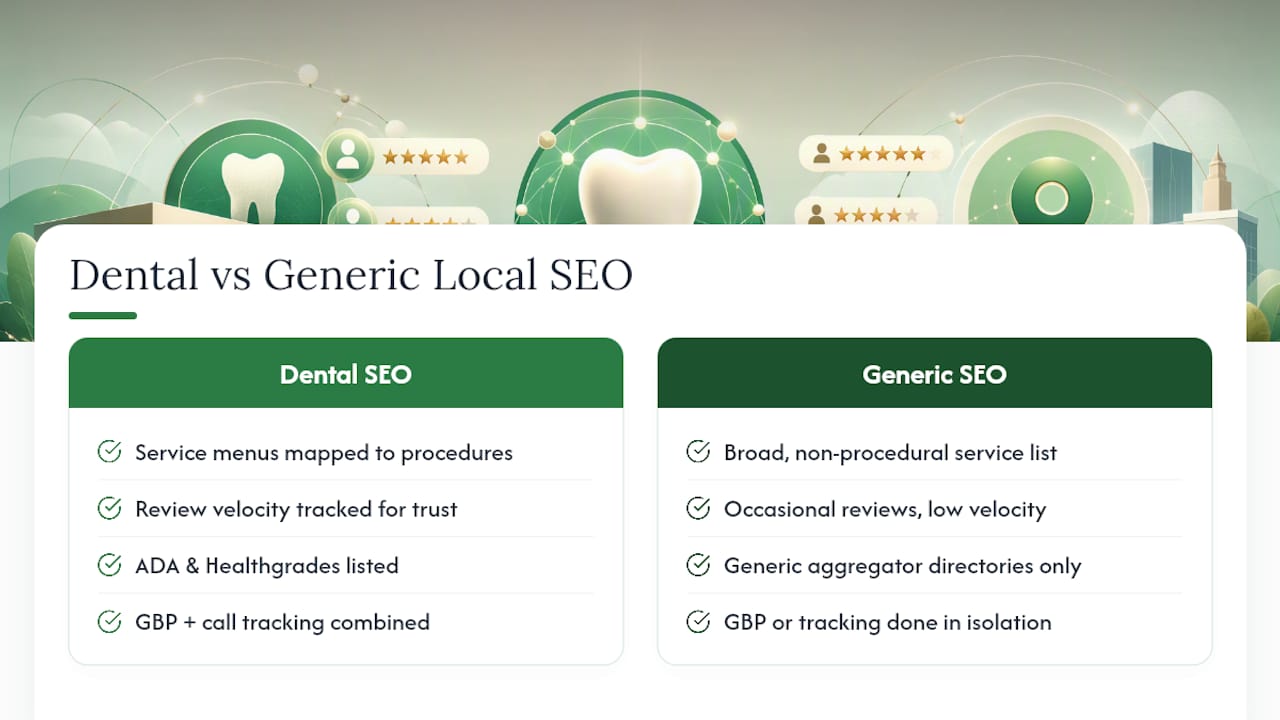
Yes, and the reason is structural, not cosmetic. A generalist approach treats a dental practice like any other local business: fix the basics, get some reviews, call it done. That misses what actually drives dental conversions, specifically service menus mapped to procedures, review velocity tied to trust-sensitive decisions like implants or sedation, and directory choices that include ADA and Healthgrades rather than just generic aggregators.
Honey Badger SEO's work with practices like the one detailed in the Arizona dental case study shows what tracked, attributed results look like when GBP optimization and call tracking are done together rather than in isolation. The month-to-month model exists because dental SEO shouldn't require a long-term leap of faith to see whether calls are actually increasing.
Should You DIY Dental SEO or Hire a Specialist?
If you're a single-location practice with staff time and steady traffic, a lot of this is doable in-house. Hiring makes sense once you're managing multiple locations, your team has no bandwidth, or your site gets traffic but few bookings. Any vendor you consider should offer full data ownership, booked-patient reporting (not just rankings), transparent month-to-month pricing, and actual dental experience. Expect early deliverables, GBP fixes and top service pages, within the first 60 days.
Honey Badger SEO: Hands-On Help for Dental Practices
Honey Badger SEO is the alternative to a traditional agency for dentist SEO, one operator managing your GBP, service pages, and call tracking directly instead of outsourcing your account to a rotating cast of contractors. That means faster fixes, fewer miscommunications, and a month-to-month arrangement with no long-term commitment holding you in place if results stall.
Early deliverables typically include a full GBP overhaul, your top five to seven service pages rebuilt around procedure and location keywords, and call tracking wired up so you can see exactly which calls came from search. Clients keep full ownership of their website, their GBP, and their data throughout the engagement, a rarity among agencies that lock practices into proprietary platforms.
If you want a straight look at where your practice currently stands, request a free dental SEO audit and get a specific list of what's costing you patients right now.
Sources
- Dental practice marketing report (MouthWatch) 2026
- Why Every Dental Practice Needs a Strong Online Presence - Dimensions of Dental Hygiene